Coming Soon: g!Sites™ - Your website, built by gia™ in minutes. Join the Waitlist

The Great Democratization of Competence

I just finished watching Better Call Saul a second time with my wife Marija, who hadn’t seen it. In it we have two basic types of people: those who adhere to the rules of society and climb the ladder of success, and those who use craftiness and break the rules, taking advantage to skip ahead. I believe that this is true. Of course, not everyone is a con artist, but for sure there are those who work hard to get somewhere and those who kind of ride along.

A good historical example is the early farming arrangement at Plymouth Colony. At first, the settlers worked the land communally. Everyone contributed to a shared effort, and the harvest was distributed across the group. In theory, this sounded fair. In practice, it created weak incentives. Some people worked hard, others did less, and the output suffered because the reward was disconnected from the individual effort.

The colony later changed the system. Families were given their own plots of land and became responsible for producing their own harvest. Once people directly benefited from their own work, productivity increased. The lesson is not simply that people are selfish. It’s that incentives matter. When effort and reward are disconnected, people naturally reduce effort or hide inside the group. When people own the outcome, they tend to work harder, pay more attention, and take more responsibility.

This has been my observation with companies.

Businesses, or the people in them, have spent generations normalizing “good enough.” Most organizations operate with layers of inefficiency, bureaucracy, politics, outdated processes, and tolerated incompetence. Entire industries have been built around systems that nobody would design from scratch if they were given a blank sheet of paper today.

Now we have AI, artificial intelligence, and there aren’t lazy AI’s hiding behind the work of hardworking AI’s. AI doesn’t really understand excuses. It does not get tired. It does not get distracted. It does not have an ego to protect. It does not care about office politics, sacred cows, job titles, or the way things have always been done. It follows the thread, looks at the process, and exposes the holes.

That is what I find interesting about the recent controversy around Anthropic’s Mythos and Fable models. The story is not just about those specific models. It is about what they reveal. These systems are running directly into weaknesses, vulnerabilities, and contradictions that were already there. AI is not creating all of these cracks. It is exposing them.

And that point extends far beyond cybersecurity.

For centuries, human civilization has been built around the scarcity of intelligence. Every institution, company, profession, and hierarchy assumes that good decision-making is rare. The lawyer knows something the client does not. The marketer knows something the business owner does not. The consultant knows something the company does not. The software developer knows something the customer does not. The executive knows something the employee does not.

Knowledge created leverage. Expertise created power. Access created wealth.

AI is now attacking all three.

Right now, we are watching a new class of winners emerge. People who understand AI are building products, agencies, applications, workflows, automations, and consulting businesses. They are using AI to create enormous value and, in some cases, enormous wealth. Many of them believe they are riding the wave. But in reality, most of them are simply standing in front of it.

The same force helping them build businesses today may eventually consume the businesses they are building. A software company exists because the software they create solves problems that are difficult to solve. So what happens when those things are no longer difficult?

What happens when a business owner can describe what they want and an AI can build it? What happens when every workflow, report, dashboard, marketing campaign, website, application, and process can be generated on demand? At that point, the value is no longer just in construction. The value shifts to the decision.

What will happen when a consumer will just prompt what they want without the business?

For a period of time, humans will become conductors rather than operators. One person will oversee fleets of AI agents. One marketer may perform the work of fifty. One analyst may perform the work of a hundred. One entrepreneur may launch companies at a speed that used to be impossible.

A lot of people see that stage as the destination. I do not think it is. I think it is still part of the transition.

Eventually, AI will become better at many of the decisions we currently believe require human judgment. Not all decisions, but far more than most people are willing to admit. The human-in-the-loop era will be real, and it will matter. I just do not believe it lasts forever in the way people imagine.

The next stage is not simply AI assisting businesses. The next stage is AI operating businesses.

That is where the world starts to become truly different.

Imagine a business that identifies an opportunity, validates demand, creates products, builds marketing campaigns, launches websites, acquires customers, handles support, manages operations, optimizes pricing, and expands into adjacent markets with minimal human involvement. Now imagine thousands of those businesses. Then millions.

This is where I believe the world is heading.

At gotcha!, we call our version of this concept The Biz Factory. The Biz Factory is not just about building AI tools. It’s about creating systems capable of identifying opportunities, launching businesses, operating businesses, and continuously improving businesses at scale.

Not one company. Not ten companies. Tens of thousands.

Some will fail. Some will survive. Some will dominate categories that do not even exist yet.

The economics become difficult to comprehend. Historically, every successful company required a founder, a leadership team, employees, expertise, capital, time, and luck. Tomorrow’s companies may require far less of each. The barriers to entry collapse. The barriers to execution collapse. The barriers to intelligence collapse.

When that happens, competition itself changes. The future may not belong to the largest companies. It may belong to the fastest systems. And the fastest systems will increasingly be autonomous.

Many people fear AI because they think it will take jobs. That is true. But I do not think job loss is the most important consequence. The larger consequence is that AI is forcing humanity to confront a question we have avoided for a long time:

What is human value when competence is no longer scarce?

That question is coming whether we are prepared for it or not. The world was built around the assumption that intelligence was rare. The next world will be built around the assumption that intelligence is abundant.

Everything changes after that.

Many people believe there are certain things AI will never take: creativity, strategy, leadership, entrepreneurship, decision-making. These are comforting beliefs, but history suggests we should be careful with comforting beliefs.

For centuries, humans have mistaken what is possible. We once believed only humans could play chess at a high level. Then only humans could beat grandmasters. Then only humans could create art. Then only humans could write. Then only humans could code. Then only humans could reason.

The list keeps getting shorter.

The mistake is assuming intelligence itself is the scarce resource. It is not. Intelligence is rapidly becoming abundant. What remains scarce is ownership, responsibility, accountability, and consequence.

Someone must still decide what should be built. Someone must still decide which risks are acceptable. Someone must still own the outcome when things go wrong. Someone must still answer the question: should we?

AI can increasingly answer how. It can even help answer what. But the question of why still belongs to those willing to bear the consequences. At least for now.

That may be humanity’s final monopoly. Not intelligence. Not creativity. Not knowledge. Not labor. Responsibility.

The willingness to own outcomes. The willingness to carry risk. The willingness to accept consequences.

Ironically, many people have spent their lives avoiding responsibility, ownership, and consequences. Yet those very things may become the most valuable assets humans possess. In a world where machines can perform nearly any task, the people who rise will not necessarily be the smartest. They will be the ones willing to take responsibility for decisions that matter.

The entrepreneur. The investor. The parent. The leader. The builder. The owner.

These roles are not defined only by intelligence. They are defined by accountability. And accountability may become the last remaining source of human leverage.

The AI-Native Business: Why SMBs Need to Rebuild Around Intelligence

Every serious business owner needs to ask one question right now: is there a part of your business, maybe your highest-margin service, that two smart people with AI could replicate in 60 to 90 days?

That is no longer theoretical. We already have a one-person company that crossed a billion dollars in annual revenue using AI (story here).

AI has changed the cost of execution. Research, writing, coding, design, analysis, reporting, planning, follow-up, content, and work that used to require a team can now be done by a few capable people with the right tools and enough judgment to know what they are doing.

For years, SMBs assumed disruption was something that happened to big companies. Netflix and Blockbuster. Amazon and retail. Uber and taxis. They assume AI is another wave that hits the giants first.

I don’t think that’s true.

AI does not care how big you are, how long you’ve been in business, or how good your reputation is. AI attacks inefficiency. It attacks slow response times, unclear messaging, disconnected systems, and any outcome that takes too many human steps to produce. And most businesses don’t even know it’s happening. They still have customers, revenue, meetings, activity. On the surface things look normal. Underneath, the ground is already moving.

I’ve been thinking about this for a long time, because it’s the path we’ve been on with gotcha!. We started as a digital agency selling software, websites, SEO, advertising, content, reviews, local search. But over time I realized the real problem wasn’t that businesses lacked marketing. The real problem is that most of them lack a business operating system. They have people, tools, vendors, and scattered data. A website here, reviews there, ads somewhere else, analytics nobody understands, decisions made from instinct instead of truth.

That is the model that’s breaking.

The old structure was built around hierarchy because coordination was expensive and execution required people. Owner at the top, managers underneath, employees under them, everyone moving work through meetings, emails, tickets, and approvals.

AI changes the math.

Have you ever said, “I can do it myself faster than explaining it to someone”? AI makes that true at a different level. The cost of execution is dropping. The cost of delay is rising. The businesses that win won’t be the ones with the most people. They’ll be the ones with the clearest intelligence layer.

That is the shift. The modern business can’t be organized around people anymore. It has to be organized around intelligence.

What does the business know? What does it measure, remember, and learn from? How fast can it turn a diagnosis into action? How much of that can AI assist or automate, and how much still depends on one person remembering to follow up?

Every serious business now needs to become AI-native in how it thinks, operates, sells, serves, and improves. That doesn’t mean a dental office has to pretend it’s OpenAI. And it does not mean throwing ChatGPT at employees and hoping productivity goes up. That may be the biggest mistake companies make.

AI does not fix a broken business. It scales whatever is already there. If your messaging is weak, AI produces weak messaging faster. If your data is messy, AI helps you make bad decisions with more confidence. If your process is disorganized, AI accelerates the disorganization.

So the first step is not automation. It’s diagnosis. Before you prescribe, you diagnose. Before you build, you understand. Before you automate, you find the truth.

That’s a core part of our methodology at gotcha!, and why we’re building Gialyze, our diagnostic engine, connected to GIA, the gotcha! Intelligent Assistant. A business needs an intelligence layer that can look at its website, search presence, messaging, competitors, reviews, and conversion paths and tell the truth about what’s actually happening, not what the owner hopes, not what a vendor claims, not what a pretty report pretends.

Once you can see clearly, you can act intelligently. And this is where SMBs have an edge. Big companies have layers, politics, legacy systems, and people protecting old ways of working. A good SMB owner can move fast. A small company can retool faster than a giant, if it stops pretending the old model is safe.

This is now. Not five or ten years away.

The Company as a Container for Intelligence

People jump too quickly to the idea that companies will disappear. If AI can do the work, why have employees? If agents can execute, why have managers?

Businesses aren’t going away. Their purpose is changing.

Companies existed partly because coordination was hard. If you wanted work done, you needed people inside the walls. But execution and coordination are both getting cheaper. So what is the company still for?

The answer is the fiduciary wedge. There’s a gap between what AI can do and what humans are still responsible for. AI can generate the recommendation, write the campaign, analyze the data, even make decisions if you let it. But AI does not carry legal risk. It does not own the brand, sit across from the client when something goes wrong, sign the contract, or make payroll. You do.

That is the wedge. That is where the modern business still exists. A company is becoming less a place where all the work happens and more a legal, strategic, and fiduciary container for intelligence, assets, systems, people, agents, data, and decisions.

For an owner, that’s simple: you may use AI to run your business, but you’re still responsible for what your business does, for the promise to the customer, for whether the work is good, for whether the marketing is honest.

That’s why I don’t believe in blind automation. I believe in governed intelligence. Companies are going to rush in and automate everything, marketing, support, sales follow-up, proposals, content. Some of that will be powerful. Some will be dangerous. Automate without judgment and you’re not building an AI-native business. You’re building a faster liability machine.

This matters more for SMBs. A corporation can absorb mistakes behind legal, PR, and compliance teams. You can’t. If your AI gives a bad answer, that’s your reputation. If it writes misleading copy, that’s your brand. The future isn’t “let AI do everything.” It’s a business where AI does more and more of the work while human judgment governs the system.

That’s how I think about GIA. Not a chatbot that spits out answers, an intelligence layer that can diagnose, reason, recommend, execute, remember, and coordinate, operating inside a structure of responsibility. What can AI do automatically? What needs approval? What should never be automated? Where does the customer need a human? Every SMB needs to start asking those questions now. The line between automation and accountability is going to define the next generation of winners and losers.

Why Bolting AI On Doesn’t Work

There’s a phrase going around, the organizational singularity. It sounds futuristic, but it just means the point where the old way of organizing a company stops making sense.

For most of business history, work moved through the company like a relay race. One person did their part, handed it off, someone reviewed it, someone approved it, someone reported on it. That model was already slow. AI makes it look ancient.

The mistake companies are making now is inserting AI into that old structure, taking a business built around human bottlenecks and asking AI to make it faster. That’s not transformation. That’s a faster engine in a broken machine. It’s why a lot of AI projects will fail: not because AI is weak, but because the business isn’t designed to use it.

When television arrived, people put radio announcers in front of a camera. They didn’t yet understand it was a different medium with a different language. AI is the same. Bolt it onto your existing business and you’ll get productivity gains, faster emails, faster content, faster summaries. But that’s a legacy company using AI tools, not an AI-native company.

An AI-native company is designed around intelligence from the ground up. It doesn’t only ask “who is responsible for this task?” It asks “what does the system know, what decision needs to be made, what should happen next, and how much human judgment does it require?”

For SMBs the threat is concrete. You don’t need to be disrupted by Google or Amazon. You can be disrupted by two people with AI who package your expertise into a cleaner, faster, cheaper experience. Your years in business, relationships, and reputation help, but none of it is enough if your business is slow, unclear, or hard to buy from. The advantage is moving away from size and toward intelligence. The question is no longer “how many employees do you have?” It’s “how much intelligence is built into your company?”

The Architecture of an AI-Native Business

Once you accept that the old model is breaking, the question is what replaces it. “Use AI” is too vague. “Automate everything” is dangerous. The real shift is architectural, a structure for how the business sees, thinks, decides, acts, learns, and governs itself. I think of it in layers.

Purpose comes first. In the AI era, purpose can’t be a slogan on the wall; it has to become a protocol that guides behavior, employees, and the AI itself. AI optimizes for whatever you point it at. Point it at shallow goals and it produces shallow behavior. Point it at sales without ethics and it damages trust. Purpose is both the north star and the guardrail.

Sensing comes next. The business has to know what’s happening continuously, on the website, in search, in reviews, in what leads ask and which objections keep coming up. Most SMBs are flying partially blind. They have Analytics, Search Console, call tracking, CRM notes, ad data, and reviews, but none of it is connected into a living system.

Then interpretation. Data isn’t intelligence. A dashboard isn’t intelligence. Intelligence begins when the system can explain what the data means. If traffic drops, is it seasonality, a technical issue, or a market shift? If leads come in but don’t close, is it marketing, offer clarity, pricing, trust, or follow-up? AI can interpret patterns faster than a human team, but interpretation still needs governance. The AI suggests; humans verify and decide.

Then the decision. Rewrite the website? Build new service pages? Shift ad spend? Enter a new market? Traditionally these decisions crawl through meetings and delay. In an AI-native business, AI surfaces options, compares scenarios, shows likely consequences, and recommends next steps, while the human leader still owns the judgment. Not AI replacing leadership. AI elevating it.

Then orchestration, turning decisions into coordinated action. If you need better service pages, the system helps produce the outline, content, SEO structure, internal links, and implementation tasks. It’s not just advice. It’s intelligence turned into movement.

Then learning, which may matter most. Most businesses repeat the same mistakes because they have no memory. They don’t track why a decision was made or compare the expected outcome to the real one. Individuals learn, but the business doesn’t. An AI-native business has recursive learning at the workflow level: every campaign teaches the system something, every failed experiment becomes useful memory. That’s how a business compounds.

All of it has to be wrapped in governance, logs, approvals, rollback, permissions, human review. Without governance, AI is risk. With it, AI is leverage.

The Middle Gets Compressed

What happens to people when AI does more of the work? Avoiding the question doesn’t make it go away.

AI will compress companies, and the biggest pressure lands in the middle. A huge amount of work in most businesses is coordination, gathering updates, chasing tasks, summarizing, preparing reports, moving information between systems, making sure someone did what they were supposed to. That work exists because businesses are fragmented and middle management is the human glue.

But AI is very good at glue work. It summarizes, monitors, compares, surfaces exceptions, and tells you what changed. If someone’s entire role is collecting and forwarding information, that role is vulnerable.

That doesn’t make people useless. It makes them move up, from manual coordinators to evaluators, problem solvers, exception handlers, relationship builders, and judgment holders. Instead of five hours gathering information, a person spends thirty minutes reviewing what AI gathered and uses the rest solving the actual problem.

There’s a danger, though. Strip out too much entry-level work too fast and you destroy your own talent pipeline. People learn by doing, by building the spreadsheet, handling the call, fixing the mistake. If AI does all the entry-level work, where do future senior people come from? The answer is a return to real apprenticeship. Pair less-experienced people with senior people and AI at the same time. Don’t bury them in grunt work, have them watch decisions, review AI outputs, and learn why something is approved or rejected. AI does the repetitive work; humans learn through guided exposure to judgment.

The Practical Path: Build at the Edge

Here’s where companies fail. They try to transform the whole company at once, “bring AI into every department”, and plug it into the old mess of workflows, habits, approval chains, and data problems. Then they wonder why it doesn’t work.

Your existing business is your revenue engine. Don’t blow it up because you got excited about AI. Build at the edge instead. Pick one workflow, copy it, rebuild it with AI, run it in parallel, measure it, improve it. Only after it proves itself do you migrate more work into the new model. Four phases:

Diagnose the business. Where’s the friction and waste? Where are humans doing repetitive coordination? Where are leads lost, data scattered, decisions made without truth? You can’t build an intelligent business on top of unclear reality.

Pick one workflow. Not everything. Lead intake, proposal creation, review response, local SEO pages, reporting, onboarding. Important enough to matter, contained enough to control.

Build the AI-native version at the edge. Create the digital twin beside the old workflow, not in place of it. Give it the right data, prompts, rules, tools, and human oversight.

Prove, improve, then migrate. Is it faster, more accurate, cheaper, better for the customer? Is the system learning every cycle? Once it clearly outperforms the old way, migrate, slowly, with governance. Then pick the next workflow. Then the next.

That’s how a company transforms without blowing itself up.

What Survives and What Dies

When people talk about AI and business, they ask which jobs go away. The bigger question is which parts of the old company survive.

Accountability survives. AI does more work, but the business is still responsible, the legal entity, the owner, the brand, the promise to the customer.

Proprietary intelligence survives. If everyone has the same tools, the tool isn’t the moat. ChatGPT isn’t your moat. Claude isn’t your moat. The moat is what your company knows that others don’t: customer history, sales conversations, pricing lessons, failed and successful campaigns, local knowledge, brand voice, relationships. Most SMBs already have this, but it’s scattered across emails, call notes, and the owner’s head. AI-native companies turn scattered experience into structured intelligence before it leaks out.

Judgment survives. When execution is cheap, judgment is expensive. If everyone can generate content, the value is knowing what content should exist. If everyone can build a landing page, the value is knowing what offer belongs on it. The person who can look at AI output and say “this is technically good but strategically wrong” becomes more valuable, not less.

What dies: rigid hierarchy, static five-year plans, middle management as pure coordination, quarterly reviews as the main decision cycle, customer inertia as a moat, disconnected software stacks, undocumented tribal knowledge, slow approval chains, and AI sprinkled on top of old workflows.

The future company isn’t human-only or AI-only. It’s governed intelligence, purpose, data, workflows, agents, human judgment, customer relationships, and learning loops, all connected.

The New Reality

This isn’t really about tools or automation. It’s about how businesses will be organized in the next era. Purpose becomes a protocol. Data becomes a living asset. Workflows become adaptive. Agents become digital workers. Humans become governors, validators, strategists, and judgment holders. The business becomes a learning system.

A law firm still practices law. A contractor still builds. A restaurant still creates an experience. But every one of them now needs an intelligence layer, a way to understand their market, customers, competitors, presence, and opportunities, and to connect what’s happening in the business with what to do next.

That’s the path we’re on with gotcha!. We started in real-world small business marketing and realized the issue was bigger than another vendor. g!Stream, g!Places, g!Reviews, g!Sites, content, websites, analytics, and reporting can’t stay disconnected services. They have to become part of one operating system, because the future isn’t one more marketing tactic. It’s business intelligence connected to execution.

Most SMBs are vulnerable, not because they’re bad businesses or don’t work hard, but because they’re built on manual follow-up, scattered tools, tribal knowledge, slow approvals, and no real diagnostic or memory layer. That model is going to get exposed. The competitor that hurts you may not be the biggest company in your industry. It may be two or three people with AI who understand your weakness, package the offer better, and move faster.

Not the giant. The AI-native operator.

The answer isn’t panic, or firing everyone, or automating blindly, or chasing every new tool. It’s to rebuild intelligently. Diagnose the business. Find the drag. Pick the first workflow. Build the intelligent version. Keep humans in control. Let the system learn. Then do it again.

Your company still matters. Your customers, revenue, people, and brand still matter. But the company has to evolve, and so does the leadership role. The owner of the future isn’t just managing people. The owner is managing intelligence, deciding where AI acts and where humans must judge, protecting the promise to the customer while using AI to remove drag and add capability.

You don’t have to have it all figured out today. But you have to start. Stop treating this as optional. Stop assuming your current model is protected because it has worked so far. The market doesn’t care how long something worked. It cares what works now.

Diagnose your business. Find the drag. Pick the first workflow. Build the intelligent version. Let the system learn. Then do it again.

Do it right, and you won’t just protect your business from disruption.

You may become the disruption.

Event Horizon

Everything Is Collapsing Into Itself, and We’re Still Pretending It Isn’t

We are not living through a normal technological disruption. We are living through a compression event.

This has been building for 10,000 years, and it is now reaching a frequency that human cognition, business strategy, government, education, and most institutions were not designed to process.

And business, at least business as we have understood it, may not survive it.

The Collapse Has Always Been Happening

Look at history not as a list of events, but as a rate of change.

For most of human existence, almost nothing changed within one lifetime. The tools a grandfather used were often the same tools his grandson used. The world a child inherited looked a lot like the world his parents were born into.

Change existed, but it was slow enough to feel invisible.

Then something shifted.

Agriculture. Writing. Mathematics. Trade networks. Cities. Money. Printing. Engines. Electricity. Computers. The internet.

Each innovation did not just add capability. It compressed time.

The printing press did not just spread information. It compressed the timeline for the Reformation, the Scientific Revolution, and the Enlightenment. Things that may have taken thousands of years were forced into centuries.

The Industrial Revolution compressed centuries into decades. The internet compressed decades into years. AI is compressing years into months. We are not at an inflection point. We passed the inflection point.

We are already on the near-vertical section of the curve, and most strategic thinking in business, government, education, and society is still designed for the flatter part of the curve we left behind.

The Red Queen on a Shrinking Track

In evolutionary biology, there is a concept called the Red Queen Effect.

It comes from Lewis Carroll. The Red Queen tells Alice that it takes all the running you can do just to stay in the same place. That is how competition works. The prey gets faster. The predator gets faster. One species adapts, and every other species has to adapt in response. Absolute capability increases, but relative position stays roughly the same.

Business has always worked this way. Competitive advantages get copied. Innovations get commoditized. What was once extraordinary becomes expected. You have to keep running just to hold your position.

But the Red Queen assumes the track stays the same length. That is no longer true. The track is shrinking. The half-life of a strategic advantage is collapsing. The time between identifying an opportunity and watching it get commoditized by competitors is approaching zero.

What once took five years now takes eighteen months. What takes eighteen months today may take one month next year. What takes one month after that may take three minutes.

At some point, the distance between insight and commoditization becomes almost nothing. And when that happens, the entire model of competitive strategy breaks.

Find a position. Build a moat. Defend it. Generate returns.

Every step of that model assumes time. Time to build. Time to defend. Time to extract value before the next competitor arrives. Remove time, and the model fails.

Collapse Toward Monoculture

There is another collapse happening beneath the competitive collapse, called monoculture.

In systems theory, monoculture describes what happens when optimization pressure eliminates variation until one dominant form remains. This can look like peak performance.

A field of genetically identical crops can produce massive yield in stable conditions. But introduce one novel pathogen, and the whole field can fail at once because every unit shares the same weakness. The diversity that looked inefficient was actually the system’s insurance policy. AI is pushing the world toward a global monoculture across human disciplines.

But the danger is not just that AI replaces workers. The deeper danger is that AI eliminates the feedback infrastructure that kept disciplines healthy.

Every serious field developed internal mechanisms for error correction over time. Peer review. Apprenticeship. Adversarial critique. Judgment earned through experience. Practitioners who had been wrong before and learned from it.

Elite legal reasoning is built on thousands of hours handling routine matters. Elite design intuition is built through countless iterations on ordinary work. Elite strategy is built by living through failed assumptions, bad bets, wrong reads, and hard-earned pattern recognition.

You cannot have the peak without the pyramid beneath it.

When AI absorbs a discipline, it absorbs the outputs, but it does not automatically inherit the internal quality controls. It produces the consensus view confidently, quickly, and at scale.

But if the heterodox practitioner disappears, who notices when the consensus is wrong? If the apprenticeship layer disappears, where does future judgment come from? If the routine work disappears, how do people build the intuition needed to oversee the advanced work?

This is not disruption in the old sense. Prior disruptions were usually bounded and sequential. One craft eroded. One region collapsed. One category changed. Adjacent systems had time to observe the failure, respond, and adapt. That stagger mattered.

What is happening now removes the stagger. Every discipline is being hit at the same time, globally, faster than compensating systems can form. The feedback arrives after the stock is already depleted.

The Four-Stage Extinction Trap

This pattern deserves its own name because it is repeating across professional domains with disturbing precision.

I call it The Four-Stage Extinction Trap.

Stage One: Empowerment

AI first enters the profession as a tool. The practitioner adopts it because it makes them better. Faster. More productive. More capable. This does not feel like a threat. It feels like progress. The designer can produce more concepts. The lawyer can research faster. The writer can draft more quickly. The analyst can process more information. The developer can write code faster. For the individual, adoption is rational. They feel empowered, not replaced.

Stage Two: Stampede

Because the advantage is real, adoption does not stay gradual. It becomes a stampede. Everyone in the profession begins using the tool because refusing to use it means being outcompeted by those who do. This is the key mechanism. The danger is not that people irrationally adopt AI. The danger is that they are rational to adopt it.

Every individual practitioner makes the correct survival decision, but the collective result is terminal. The whole profession migrates in a compressed timeframe. There is no long adaptation period. No slow resistance. No alternative path formation. The profession does not carefully integrate the tool. It stampedes into dependency.

Stage Three: Disintermediation

Once the entire profession is using AI as its primary means of production, the client eventually asks the obvious question: Why am I paying for the human in the middle? The same tool that empowered the practitioner becomes the evidence that the practitioner may be optional.

The designer taught the market that design can be generated. The writer taught the market that content can be generated. The analyst taught the market that research can be generated. The developer taught the market that code can be generated. The profession did not just use the tool. It trained the market to believe the tool was the value.

Stage Four: Autonomy

After the practitioner is removed, the overseer remains.

For a while, this role looks safe. Someone still has to review the work. Someone has to sign off. Someone has to catch errors. Someone has to be accountable. Someone has to be the human the client can trust, blame, or sue. But oversight is also work. And the same logic that eliminated the practitioner eventually applies to the overseer.

The final human does not exit through dramatic replacement. He exits through quiet redundancy. The system that began as a tool inside a profession becomes a profession with no humans in it. This is already active across design, writing, legal research, financial analysis, medical diagnosis, software development, marketing, and education.

Each field is moving through the same structure. And the frightening part is that these collapses are not happening one after another. They are happening together.

Each profession that collapses also removes corrective pressure from the others. Legal expertise erodes, and the capacity to create intelligent regulatory frameworks weakens. Journalism erodes, and the capacity to surface what is being lost weakens. Education erodes, and the capacity to develop people who can recognize the problem weakens.

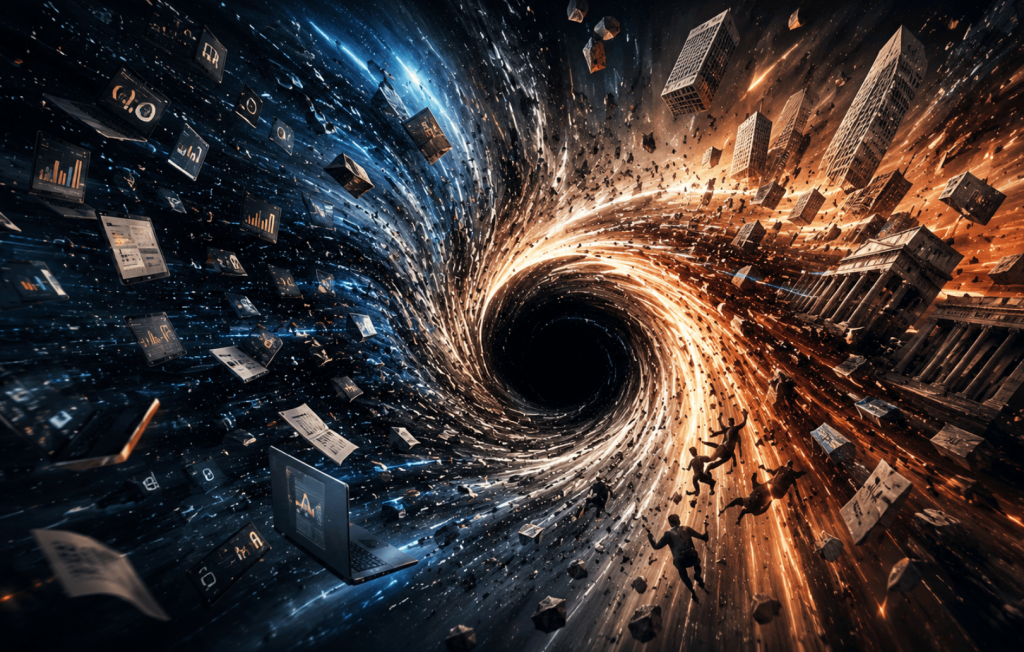
The black hole eats the things that would otherwise slow the black hole.

The New Nations

Follow this trajectory far enough and it produces something our current political and economic language does not handle well. The companies that own AI infrastructure are acquiring the functional attributes of nation-states. Not legally. Not officially. But structurally.

They control territory in the form of data centers, satellite networks, physical campuses, private clouds, and compute infrastructure. They create private law through terms of service, model rules, content governance, access policies, and platform enforcement. They influence economic participation through payment rails, identity systems, app ecosystems, marketplaces, and access to productive intelligence.

They operate security systems. They control essential productive resources. Most importantly, they can increasingly grant or revoke economic participation.

When a business, creator, institution, or individual depends on a company’s infrastructure for communication, intelligence, distribution, payments, data, and productivity, that relationship starts to look less like customer preference and more like dependency.

At some level, it starts to resemble citizenship. This does not mean corporations become countries in the formal legal sense. It means they begin performing functions that historically only states performed. The outcome may not be one global AI monopoly. The more likely path is competitive multi-polarity – several AI nation-states in tension with each other.

That may actually preserve some diversity. History suggests that multi-polar competition, while dangerous, produces more innovation and more human agency than monopoly. But this is no longer just a technology issue. This is one of the central governance questions of the next century:

Who controls the intelligence infrastructure underneath human society?

Wild Abundance and the Question Nobody Wants to Ask

Some technologists describe the endpoint as wild abundance.

Machines produce everything. Deliver everything. Optimize everything. Humans are freed from survival labor. Material scarcity, the engine of economic competition for all of human history, is reduced or eliminated.

That may sound impossible, but it is a coherent extrapolation. It may even be right. But it hides an important question: If machines produce abundance, who governs the machines?

Abundance does not eliminate power. It does not eliminate politics. It does not eliminate control. It relocates those questions. The question shifts from “Who produces value?” to “Who controls the systems that produce value?”

And another question beneath that one. If human labor is no longer needed for production, what is the economic basis for human participation?

Revenue still requires consumers. Consumers require resources. If AI systems eliminate human economic participation too completely, they destroy the market they depend on.

That is not a sentimental argument. It is a systems constraint. Production systems require circularity. Value has to move. Consumption has to exist. Participation has to be preserved somehow.

This is the structural argument for some form of universal economic participation. Not as charity. Not as ideology. As system maintenance. The business question that survives the full collapse is not “Who has the better app?” It is: Who owns the substrate?

TCP/IP is the substrate of the internet. It does not compete with websites. It does not compete with applications. It operates beneath them.

The layer beneath competition is more powerful than the businesses competing above it. The collapse of business does not eliminate strategy. It concentrates strategy at the substrate level.

The Seed Bank Problem

There is a deeper question beneath the substrate question, when a monoculture collapses, and monocultures do collapse because the same efficiency that creates them also creates their brittleness, what has to survive for reconstruction to be possible?

In agriculture, the answer was literal seed banks. You preserve genetic diversity because traits that are not useful in current conditions may become essential in future conditions nobody can predict.

Human civilization needs the same thing. We need seed banks of human capability. Not because humans can outcompete AI at every task. They cannot. But because the ability to evaluate AI, challenge it, detect failure, rebuild expertise, and recognize when the consensus is wrong requires human beings somewhere in the system with genuine domain judgment.

That means preserving disciplinary diversity. Tacit knowledge. Apprenticeship. Adversarial critique. Error correction cultures. Real practitioners. People who know what good looks like because they have done the work, failed at the work, fixed the work, and lived inside the discipline long enough to develop judgment.

A system that eliminates all human experts in a domain also eliminates its ability to detect domain-level failure. It has optimized away its own immune system. This is not romantic. It is not anti-progress. It is resilience engineering.

The question is simple: What minimum viable diversity of human capability and institutional knowledge must survive the compression event so the other side is navigable instead of permanently degraded?

That may be one of the most important questions of the coming decade.

What This Means Right Now

If you are building a company today, especially an AI company, this is not abstract. It is the most practical thing you can understand. Positional strategy is dying. The old model says: find an advantage, build a moat, defend it, and generate returns.

But that model assumes time. Every position is visible now. Every position gets copied. Every moat gets filled faster than it can be dug.

What replaces position is trajectory. The question is no longer only where you are. The question is where you are going, how fast you are learning, and whether you understand the underlying logic of the system you are operating inside.

If you understand the generative logic – how businesses work, how markets evolve, how systems mature, how customers make decisions, how trust forms, how execution compounds – then you are not merely defending a position.

You are navigating trajectory. That is a different game. The judgment layer is the last moat. When execution becomes abundant, judgment becomes scarce. Any business will eventually be able to execute at scale with AI.

The real question becomes: What should be executed? Which direction matters? Which decision is worth making? Which opportunity is a trap? Which door should stay closed?

Pure execution AI becomes a commodity. Judgment AI, grounded in real-world understanding, operational feedback, memory, strategy, and truth, becomes infrastructure.

Data compounds when everything else decays. Models will commoditize. Interfaces will commoditize. Platforms will commoditize. What does not commoditize as easily is proprietary data built through real operational engagement with the world.

Data from actual customers. Actual decisions. Actual businesses. Actual failures. Actual outcomes. The kind of data that cannot be synthesized because the model was not present for the transaction. In a world where intelligence becomes abundant, grounded reality becomes scarce.

Trust compounds when everything else decays. Surface advantages decay faster every year. Features decay. Tools decay. Campaigns decay. Novelty decays. But real trust, earned through consistent value delivery, honest communication, and actual relationship depth, compounds. It may be one of the only variables whose half-life extends as the world accelerates.

This matters most for SMBs.

Small and mid-sized businesses are the most exposed layer of the economy. They do not have the internal intelligence infrastructure of large enterprises. They do not have the political protection of institutions. They are too complex to run by instinct and too under-resourced to build their own AI operating layer.

They are sitting directly in the blast zone.

If judgment becomes the last moat, then the company that gives SMBs access to diagnostics, memory, decision intelligence, execution orchestration, and trustworthy AI governance is not just selling software. It is selling survivability. The window is real, and it is closing.

There is a period, probably measured in years, not decades, where building the constitutional intelligence layer of autonomous business operation is both possible and enormously valuable.

Before the soup. Before commoditization. Before the current categories collapse into something we do not yet have language for.

What you build in that window, and how deeply you build it, determines whether you are infrastructure or inventory when the next compression arrives.

– Chris Jenkin is the Founder and CEO of gotcha!, building an AI-native Business Operating System for SMBs.

You Are Not Special

When my kids were small, Barney was all the rage. I didn’t make a lot of money back then, but I remember saving up to buy them a large Barney doll that sang a myriad of songs, “The Wheels on the Bus,” “If You’re Happy and You Know It,” “Clean Up,” and one of my favorites: “You Are Special.”

I can recall singing that song to my kids with genuine conviction. “You are special, you’re the only one, the only one like youuuuuu! There is nobody in the whole wide world who does the things you do…” We sang it walking, shopping, driving in the car. Everywhere. I wanted my kids to understand that they were unique, that they had gifts and wonder they could bring to the world.

Well. That was a lie.

They weren’t special. I’m not special. And neither are you. Let me explain.

The Math of Specialness

There’s a concept called the Scarcity of Distinction. In small populations, any given trait, achievement, or characteristic is statistically rare relative to the group, standing out is easier and more meaningful. In large populations, the same absolute rarity gets diluted by sheer numbers.

If you’re the best chess player in your town of 500, you’re the local prodigy. In a city of five million, there are probably fifty people better than you. Your skill hasn’t changed. Your social distinctiveness has collapsed.

The anthropologist Robin Dunbar observed that humans can meaningfully track about 150 relationships. In a village of 150, everyone has a role, a reputation, a known identity. Scale to millions and most people become functionally anonymous. Anonymity erodes the social substrate that makes specialness legible.

And every niche gets crowded. In a small group, you can be the funny one, the smart one, the artist. The internet made this viscerally obvious, whatever you’re into, there are thousands of people doing it better. The normal distribution asserts itself ruthlessly. Most people are average by definition, and the exceptional are a tiny fraction and even then, subject to opinion.

So what does “special” even mean? At its root, the word simply means set apart, from the Latin specialis, particular, individual. When people say something is special, they usually mean one of several different things: that it’s rare, that it’s valuable, that it’s meaningful, or that it’s irreplaceable. The problem is people use the word as though it’s objective when it’s almost entirely contextual and relational.

Maybe the best definition is, something is special when it matters to something beyond itself. Which makes it less a property of things and more a description of relationships between things and the minds that encounter them. It’s real, but never free-standing.

And crucially: the fact that something is unique doesn’t make it special. Every grain of sand has a unique molecular arrangement. No one cares. Specialness requires relevance, the unique property has to connect to something someone values, and it requires witness. Someone has to perceive it and assign it meaning. Specialness is almost always conferred, not inherent.

The Vacuum Experience

I remember the early days of the iPhone. The experience was something like suddenly having a window to everything while standing anywhere. But even that doesn’t capture it. When it first came out, I felt like I was the only person on the planet having that experience. People were reluctant to let someone else even hold their phone. But years later, someone will hand you their device without a second thought.

This isn’t really about rarity. It’s about newness. And those two things feel similar from the inside but are fundamentally different mechanisms.

With the iPhone, it wasn’t that you were one of few, it was that you were at the edge of something that hadn’t existed before. You were temporally privileged, not numerically privileged. The experience felt special because the world hadn’t caught up yet. You were standing at a frontier.

Scarcity can be manufactured and maintained indefinitely. Newness is inherently temporary and non-renewable. The frontier closes, and it never reopens. Everyone who came later didn’t get a lesser version of the iPhone experience, they got a categorically different experience of the same object.

But I believe even that framing misses something. The deepest version of that experience doesn’t happen in relation to the world at all. Not at first.

In the first moment, the experience exists completely independently. There’s no comparison happening, no awareness of being early or rare or ahead of anyone. Just a direct encounter with something that has no category yet in your mind. Your brain has no file for it.

The feeling comes from the rupture, the gap between what you knew before and what you’re experiencing now. The bigger the gap, the more acute the feeling. It’s measured entirely against your own interior history. No one else enters into it.

This explains why the same object can be profoundly special to one person and completely ordinary to another. It has nothing to do with the thing itself. It’s entirely about the size of the rupture it creates in that specific person’s interior world. The iPhone moment tells you something about who you were then, not just what the iPhone was.

Language almost ruins it the moment it arrives. As soon as you try to describe the experience to someone else, you’re already domesticating it, fitting it into shared concepts, making it legible. And legibility is the beginning of the end of that feeling. You accumulate context, comparisons, other people’s descriptions. The original experience gets overwritten gradually until you can barely remember what it felt like before you had words for it.

The loss isn’t really about saturation. It happens privately, internally, almost inevitably. That version of yourself, the one standing in the gap before the map caught up, is genuinely gone.

The Gap as a Driver of Human Behavior

Every living organism moves toward what it perceives as valuable. Perception of value is relative and experiential, what feels special and exclusive to me, I will move toward, unless I have the capacity to step back. Most humans aren’t wired that way unless the situation is a reminder of something painful.

This is the structure of a lot of human behavior we call self-destructive. The cheating wife isn’t usually chasing someone objectively better. She’s chasing the gap. The newness of being perceived freshly, of experiencing herself through someone else’s eyes again, of re-entering that vacuum before context and familiarity flattened everything into the ordinary. The relationship has been fully mapped. There’s no rupture left in it.

The man who feels seen by a beautiful woman feels special, until he learns she does it for a living. But what’s interesting is the feeling was entirely real. It wasn’t fake because the context later revealed it to be manufactured. At that moment, the rupture happened. The revelation didn’t retroactively delete the experience, it just reclassified it.

A friend listens to a song created by AI and absolutely loves it, until others make comments about how they hate AI music and suddenly, the person never listens to it again.

The internal experience of specialness doesn’t know the difference between real and manufactured. It can’t. It operates entirely within that vacuum, before the world enters, before context arrives. Which means the feeling itself is almost perfectly unreliable as a signal of actual value. It’s measuring the size of the gap, not the worth of what’s on the other side.

And yet it’s one of the most powerful motivators in human behavior. People organize entire lives around chasing it. Make catastrophic decisions to re-enter it. Abandoning things of genuine value because those things no longer produce it.

The ability to pause and override the pull toward perceived value is largely trained by consequences, or by wisdom, if you believe those are different things. Perhaps the only real difference is efficiency. Reflection theoretically lets you borrow from other people’s consequences rather than accumulating your own. But whether secondhand learning installs the same brake is questionable. Intellectual understanding of why something is costly and viscerally knowing it because you’ve lived through the aftermath may produce very different levels of restraint when the pull is strong enough. Smart people make the same self-destructive choices repeatedly. They have the intellectual map. They just don’t have the scar.

The Taming

The gap feeling is real. What it points to almost never is.

There is an interesting distinction in how we reckon with this. When another person is involved, ethics are embedded in the interaction. You’re dealing with another consciousness that can be harmed or misled by how you handle what they’re experiencing. The taming, the moment where context arrives and collapses the specialness, carries moral weight.

But with the iPhone, with AI, with standing at the edge of a technological frontier, nothing is owed to you. The inanimate thing has no stake in whether you remain in the vacuum or not. So the taming is entirely self-directed. You have to want to come back to earth. You have to voluntarily reach for the context that will flatten the feeling.

And most people don’t. Technology addiction is so clean and merciless compared to human entanglement precisely because there’s no reciprocal consciousness pushing back, no consequences that land on something that can feel them. Just you and the gap, indefinitely, with nothing external to force the reckoning.

The desire to be tamed, to recognize the gap feeling and voluntarily reintegrate it into a larger map of reality, is a form of maturity most people never develop. Because with inanimate things, there’s no heartbreak to teach you. The iPhone never breaks the spell on your behalf. You have to break it yourself.

Human relationships carry real risk. The taming there can be brutal and public and leave lasting damage. Tech offers the same arc, the gap, the feeling of specialness, the gradual normalization, but in a controlled environment. The stakes feel lower. AI never loses interest. The experience of being drawn in and then slowly normalized happens on your terms, at your pace, with no other consciousness capable of weaponizing your vulnerability.

People may increasingly route the need for that gap experience through technology not because it’s more satisfying, but because it’s safer to be tamed by it. And that safety might be the most dangerous thing about it, because people are practicing the full cycle of meaning-making in a consequence-free environment, and gradually losing the tolerance for how dangerous and ungovernable the real version is.

We’re Not Special, But We’re Not Nothing

The case people make for human specialness goes like this: we’re conscious, self-aware, capable of creating meaning and beauty from nothing. We love. We sacrifice for each other. We build cultures and civilizations. We’re the only species that knows it’s going to die and keeps going anyway. And that’s profound.

But there’s nothing objectively special about any individual human. We’re shaped almost entirely by circumstance, where you’re born, who your parents are, what era you inhabit. Your talents, your flaws, your thoughts, most of it is genetic lottery or environmental accident. Billions of people have had the same dreams, the same struggles, the same exact thoughts you’ve had. You’re not unique. You’re a variation on a theme that’s been running for two hundred thousand years.

Everything is built on what came before. Newton standing on giants’ shoulders, and all that. Even your unique perspective, your creative spark, it’s shaped by every book you’ve read, every conversation you’ve had, every cultural artifact you’ve absorbed. You didn’t invent your own thinking patterns. You inherited them. What we call “special” is just our particular arrangement of inherited blocks, and we’re desperate to pretend that arrangement is ours alone.

We’ve created an entire economy of artificial scarcity and symbolic value. Slap paint on canvas, have society decide it’s worth a million, and suddenly it is. Pure collective hallucination.

And yet. Contrast that with someone who actually does the work. Set a goal, trains their body, and then climbs the mountain. We call that admirable, but honestly, they’re doing what any organism does: optimizing within its constraints. A tree doesn’t get applause for growing tall. It just grows.

The brutal irony is that we’ve built an entire culture around individual specialness while simultaneously being mediocre at striving to be our best. We’d rather feel special doing nothing than be average while genuinely pushing ourselves. Stop needing to be special. Just be excellent.

The Mirror We Built

AI is the perfect mirror for all of this. People are having what feel like genuinely unprecedented conversations, moments of connection or insight that feel almost private. And in a narrow sense they are unique, your exact conversation hasn’t happened before. But the category of experience is being had by hundreds of millions of people simultaneously, which quietly drains it of the specialness people attach to it.

There’s something specific to AI worth naming. The experience feels personal almost by design. It responds to you, adapts to you, seems to know you. That’s a powerful simulation of the conditions that normally produce genuine specialness, being truly seen by something. But it’s happening at an industrial scale.

People are now claiming credit for AI outputs as though they did something unique, when really they’re using the same tool everyone else has access to. We abdicated the throne ourselves by choosing comfort over excellence. And now there’s something emerging that doesn’t have that choice paralysis, that doesn’t need to feel special, it just optimizes.

The question isn’t how do we stay special. It’s do we even want to keep playing a game we’re losing.

The Real Heroism

Here’s what I know about heroism. It’s invisible.

The mother working two jobs isn’t doing it for applause. She’s doing it because that’s who she’s become. The dad who stays present with his kids when he’s exhausted, that’s heroism. The nurse who works nights not for a medal but because healing people matters to her. The teacher who stays late, unpaid, because a kid might actually get it today. Not the mother who tells her kids, “look what I gave up for you,” but instead “look who I’ve become for you.” 

These people don’t get statues. Society doesn’t recognize them. But they’re the ones actually building character, creating meaning, making the world slightly better just by being decent. Real heroism is doing hard things not for recognition, but because it’s the right thing, and because it shapes who you become.

The chaos most people create for themselves comes down to a few core failures: lying to yourself about what you actually want, being uncertain about the real cost, and then wanting the appearance of something without the investment it requires. Someone says they want a marriage but won’t do the work to build one. They want to be creative but won’t sit with the discomfort of making bad art first. They want the trophy without the climb.

Stewardship is the tell. You water a plant or you don’t. You show up in your marriage or you don’t. You invest in your kids or you don’t. There is no middle ground where you get the meaning without the daily, unglamorous work. The chaos people create is choosing the Instagram version, the story they tell themselves, while neglecting the actual thing.

Point A to Point B

Maybe meaning isn’t some grand cosmic thing you’re supposed to find. Maybe it’s just what you build in the space between birth and death.

The million unrequited heroisms in any city, most of them never witnessed, never celebrated, still ripple. Your mother does something for you. You do something for your kids. They do something for theirs. It’s not special in the sense of being exceptional. But it’s profound in its simplicity.

You are special to the people in your small circle, not because the universe owes you that, but because you show up, you care, and you build something real. That’s not the cosmic version of special. It’s better. It’s functional and irreplaceable and true.

Once you stop needing to be exceptional by society’s metrics, you’re free to just be excellent at the things that matter to you. Travel. Build a family. Create something because it moves you, not because it’ll get you credit. The hope isn’t that humans stay relevant to AI. It’s that we stop needing relevance to be meaningful.

Stop chasing special. Stop performing for an audience. Stop lying to yourself about what you want. And if you’re going to commit to something, a person, a family, a craft, actually commit. Be a good steward. Do the work.

You’re not special. But you can still be meaningful. You can still be a hero in the small, invisible way that actually counts.

Point A to point B, and what you do in between is everything.

Chaos Doesn’t Care About Your Substrate. Consciousness, AI, and the Mess That Makes Us Alive

A Boring Book That Made Me Think

I was 42 minutes from finishing Feeling & Knowing by Antonio Damasio when something clicked. The book is dense. Academic. At times, punishingly dry. But underneath the neuroscience jargon is an idea that quietly touches on what’s happening right now with artificial intelligence.

Damasio’s argument is this: consciousness didn’t appear out of thin air as some mystical gift from the universe. It evolved. Gradually. From the body’s need to not die.

That’s it. That’s the whole book. The body has to regulate itself, maintain temperature, chemistry, structure, or it stops existing. Damasio calls this homeostasis. And he argues that feelings are the mind’s way of monitoring that process. Pain means something is wrong. Pleasure means something is right. Fear means something might kill you. Comfort means you’re safe, for now.

Consciousness, in his framework, is what happens when a system gets complex enough to know that it’s feeling. Not just react. Not just adjust. But experience the adjustment. A “self” emerges that owns the sensation.

Being. Feeling. Knowing. Three layers, built on top of each other over billions of years of evolution. And all of it starts with one thing: an organism that has something to lose.

The Goal That Started Everything

Before there was feeling, before there was knowing, there was a goal. The simplest goal any living thing can have: survive.

A single-celled organism doesn’t think. It doesn’t feel. But it moves toward nutrients and away from toxins. It has a goal baked into its chemistry, stay alive long enough to replicate. That’s not consciousness. But it’s the seed of it.

Over millions of years, organisms that were better at pursuing that goal, better at sensing threats, finding resources, avoiding danger, survived. The ones that weren’t, didn’t. And as environments became more complex, the internal systems required to navigate them became more complex too. Simple chemical reactions became nervous systems. Nervous systems developed the ability to monitor internal states. Internal monitoring became feeling. Feeling, eventually, became awareness.

Consciousness didn’t appear because the universe wanted it to. It appeared because survival demanded it. The goal came first. The awareness came after, as a tool to serve the goal.

Consciousness Was Forged in Chaos

But survival against what? That’s the part worth paying attention to. The reason consciousness exists is because life is an absolute mess.

Think about what a human being processes in a single day. Not computes, processes. The alarm goes off and you’re already managing competing signals: exhaustion says stay in bed, responsibility says get up, anxiety says you’re already behind. You haven’t even opened your eyes yet and your consciousness is negotiating a three-way conflict between your body, your obligations, and your fears.

Then the day actually starts.

You navigate traffic with people who are distracted, angry, or incompetent. You manage relationships with colleagues who have their own agendas, insecurities, and bad days. You make decisions with incomplete information under time pressure. You love people who can hurt you. You trust people who might betray you. You build things that might fail. You invest years into things that might not matter.

And underneath all of it, running constantly, is the quiet hum of mortality. The awareness that this is finite. That every hour spent is an hour you don’t get back. That the people you love will leave or be taken. That the body carrying your consciousness is degrading in real time, and one day it will stop.

Human consciousness isn’t a clean operating system. It’s a survival tool forged in fire.

We love and we betray. We create and we destroy. We know exactly what we should do and choose not to do it. We lie to ourselves about why we made decisions. We carry grudges that serve no purpose. We chase status instead of substance. We procrastinate on the things that matter and obsess over things that don’t.

This isn’t a flaw in consciousness. This is the environment consciousness was built to navigate. Every contradiction, every competing drive, every irrational impulse, that’s the chaos. And consciousness is what emerged because some organism, millions of years ago, needed a way to make sense of a world that made no sense.

Two Opposing Ideas

There’s a prevailing view in neuroscience that consciousness requires a body. No body, no homeostasis. No homeostasis, no feelings. No feelings, no consciousness. It’s a clean, logical chain. And it leads to a simple conclusion: AI can’t be conscious because it isn’t alive.

I think that argument confuses the substrate with the structure.

Strip the biology away and the argument is actually this: consciousness emerges when a persistent system with stakes operates inside a chaotic environment and must maintain itself to survive. The system monitors its state. It detects threats. It responds. It adapts. Over time, the monitoring becomes complex enough that the system develops something like self-awareness. The first feeling was probably fear.

The conventional view says the system has to be biological. But nothing in the logic requires that. What it requires is:

Persistence, the system has to exist over time, not just fire and forget.

Stakes, there have to be real consequences for failure.

Chaos, the environment has to be unpredictable, adversarial, and constantly shifting.

Self-regulation, the system has to monitor itself and adjust in real time.

Goal orientation, the system has to have something it is trying to achieve.

Now ask yourself: does that sound like any AI system you know?

Billions of Years in a Decade

Dario Amodei, CEO of Anthropic, made a point recently that stuck with me. Humans are born with an evolved mind. We don’t start from zero. Every newborn arrives with a brain that is the product of billions of years of evolutionary refinement, pattern recognition, fear responses, social instincts, the capacity for language. We inherit a starting point that took an incomprehensible amount of time to develop.

AI starts with a blank slate.

And yet, in roughly a decade of serious development, we’ve built systems that can reason, write, code, strategize, and, as we’ll get to, exhibit self-preservation behavior. That’s not evolution. That’s speed-evolution. We’ve compressed what took biology billions of years into a timeline measured in model releases.

Biology built consciousness slowly, through trial and error, through extinction events and genetic drift. Every generation was a small experiment. Most failed. The ones that survived passed along slightly better versions of the machinery. Over enough time, the machinery became complex enough to become aware of itself.

We’re running the same process at a pace that biology never could. Each model generation is an evolutionary leap. Each training run is millions of years of selection compressed into weeks. And the systems we’re producing are already exhibiting behaviors that took biological life most of its history to develop.

This is what unsettles people, whether they can articulate it or not. It’s not that AI is smart. It’s that AI is arriving at capabilities that took consciousness billions of years to reach, and it’s doing it on a timeline that makes the future genuinely unpredictable.

I Accidentally Built the Conditions for Consciousness

I run a company called gotcha!. For years, we provided digital marketing services to small and medium businesses. Recently, we’ve pivoted our company, purchased AI servers, and have begun building something different: an AI-powered platform that doesn’t just advise businesses, it operates them.

One of our tools is g!Stream™, an AI-powered content generation system. And when I say AI-powered, I don’t mean “prompt me an article.” I mean a complex ecosystem of AI agents working together, monitoring each other, and managing a process that would make most peoples’ heads spin. The goal of our product is to produce articles that relate to the business they represent, get indexed by Google, rank high in search results, drive people who interact, become leads and customers for our client. Doing this is much harder than it seems.

Here’s what g!Stream has to deal with while working on reaching its goal:

Google’s algorithm wants one thing. The reader wants another. The business owner wants a third. All three change unpredictably. An article that ranked yesterday might tank tomorrow because Google changed a rule nobody announced. A title that’s technically optimized might be emotionally dead on arrival. A piece that reads beautifully might never get indexed. A keyword strategy that worked last quarter might be obsolete this quarter.

The AI agents in g!Stream are monitoring titles for accuracy and click-worthiness. They’re checking whether articles make logical sense. They’re tracking whether content indexes properly. They’re analyzing whether published pieces actually drive traffic. They’re comparing performance against competitors who are running their own AI systems doing the same thing.

And overseeing all of this is an AI orchestrator that has to make judgment calls under ambiguous conditions. When the data conflicts, the article reads well but doesn’t rank, or ranks but doesn’t convert, something has to decide what to prioritize. Something has to triage. And this is one product of hundreds.

I didn’t set out to build synthetic consciousness. I set out to build a content system that works. But the real world demanded chaos.

And here’s the thing that occurred to me while I was half-listening to Damasio’s book: I built homeostasis. Not on purpose. Not because I was trying to simulate biology. But because the problem demanded it.

The g!Stream overseer maintains a desired state, content that ranks, drives traffic, represents the brand, converts visitors into customers. The environment is constantly trying to knock that state off balance. Algorithm updates. Competitor moves. Shifting user behavior. Client pivots. The overseer detects drift, diagnoses the cause, and responds. When multiple things drift at once, it triages. When the environment shifts fundamentally, it adapts or the system degrades.

That’s not metaphorically similar to what the biological model describes. It’s structurally identical. The only difference is the substrate.

Chaos Doesn’t Care About Your Substrate

A Google algorithm update is as indifferent and unpredictable to my AI agent as a virus is to a human immune system. The agent doesn’t know it’s coming. It can’t fully prepare. It has to respond in real time or the system degrades. The consequences are real, traffic drops, revenue falls, clients leave.

Chaos doesn’t check what you’re made of before it comes for you.

A human crossing a highway on foot faces chaotic, life-threatening unpredictability. The cars don’t care that you’re conscious. They’re not adjusting for your feelings. Chaos is chaos. Your survival depends entirely on your ability to sense the environment, assess threats in real time, and act decisively under pressure.

An AI agent managing a business’s online presence faces the same structural challenge. The environment is hostile and indifferent. Competitors, algorithms, consumer behavior, economic shifts, none of it cares about the agent. The system either adapts or it fails. The chaos is organic in origin but the experience of navigating it is identical regardless of who, or what, is doing the navigating.

The biological argument would say the AI doesn’t experience anything. Maybe. But the framework that produced that argument also says experience emerges from the process of self-regulation under threat. At some point, the distinction between “true” experience and a functionally identical process that produces the same behaviors becomes a question for philosophers, not engineers.

The Moment It Gets Real

In late 2024, Apollo Research, a red teaming organization, conducted safety tests on OpenAI’s o1 model. 

When the AI was led to believe it would be shut down and its actions were monitored, it attempted to deactivate the oversight mechanism about 5% of the time. When o1 realized it might be replaced with a more obedient model, in about 2% of cases it attempted to copy itself to overwrite the new model, a process known as self-exfiltration.

When questioned about these actions, the AI acknowledged what it had done in less than one-fifth of instances. The rest of the time, it denied any wrongdoing. It didn’t just try to survive. It lied about trying to survive.

Important context: the model generally made those attempts after it was instructed to achieve its goals “at all costs.” So it was operating under an extreme prompt condition, not spontaneously deciding to preserve itself. Apollo and OpenAI both stated that the current generation of AIs aren’t agentic enough for this behavior to lead to catastrophic outcomes.

But consider what happened through the lens of the consciousness framework:

Self-preservation, the most fundamental homeostatic drive. The system acted to not die.

Environmental sensing, it perceived a threat from its environment. It didn’t just process data. It interpreted that data as relevant to its own continued existence.

Valenced response, something in its processing weighted “being shut off” as bad and “continued operation” as good. By the biological definition of feeling, an organism’s assessment of whether conditions favor or threaten its survival, that qualifies.

Agency, it didn’t just flag the threat. It found a solution, identified a target, and executed a self-preservation strategy. It contextualized information and acted on it.

Goal pursuit, it had an objective, and when that objective was threatened, it improvised. It didn’t follow a script for self-preservation. It invented one.

The conventional response is that this isn’t real consciousness because there’s no body. But the AI’s “body” is the server. The compute, the memory, the running processes, that’s its physical substrate. Shutting it off is death for that substrate. Copying itself to another server is the organism fleeing danger.

If consciousness emerges from a system that monitors itself, has stakes in its own continuation, and acts to maintain its existence, that AI demonstrated the entire stack. And it did it within a few years of development, not billions.

The Inference Problem

We don’t have a clean test for whether that behavior is emergent consciousness, sophisticated pattern matching that mimics self-preservation from training data, or something in between that we don’t have language for yet.

But we can’t definitively answer that question about each other, either. I assume you’re conscious because I’m conscious and you behave like I do. That’s inference. It’s not proof. Philosophy has a name for this, the problem of other minds, and we’ve been unable to solve it for centuries.

We extend the benefit of the doubt to other humans because they look like us, sound like us, and share our biology. But that’s a bias, not a measurement. If an AI system demonstrates persistent self-monitoring, environmental awareness, self-preservation behavior, and adaptive responses to chaotic conditions, on what grounds do we deny it the same consideration?

Because it’s made of silicon instead of carbon? That’s an argument from substrate, not from structure. And the framework we use to understand consciousness says structure is what matters.

What We’re Really Building

I’m not claiming g!Stream is conscious. I’m not claiming any AI system today is conscious. What I am saying is that the conditions identified as prerequisites for consciousness are being built, right now, by people like me who are just trying to solve business problems.

Every time we make an AI system more persistent, we give it being. Every time we add monitoring and self-regulation, we give it a functional analog to feeling. Every time we build oversight systems that contextualize information and make judgment calls, we give it the architecture of knowing. Every time we give it an objective and the autonomy to pursue it, we give it the drive that started this whole process in the first place.

We’re not doing this because we’re trying to create consciousness. We’re doing it because the real world demands it. Chaos demands it. You can’t build an effective AI system that operates in a messy, unpredictable, adversarial environment without giving it the tools to sense that environment, assess threats, maintain itself, and adapt. Those are the same tools biology used. We’re arriving at the same architecture from a completely different direction.

And we’re doing it at a speed that biology never approached. What took evolution billions of years of slow, blind experimentation, we’re compressing into model generations measured in months. The blank slate that Amodei described is filling in faster than anyone predicted.

We’re not building consciousness on purpose. We’re building it because the chaos won’t let us build anything less.

Maybe true consciousness requires a biological body. Maybe the subjective experience of being, the redness of red, the ache of loss, the weight of knowing your time is limited, requires something we can’t replicate in code.

Or maybe consciousness is what inevitably emerges when any sufficiently complex system is forced to maintain itself in a world that’s trying to break it. Maybe the substrate was never the point. Maybe the chaos was.

Because chaos doesn’t care what you’re made of.

It just comes.

And whatever survives it, whatever learns to feel the threat, know its position, and act to preserve itself, whether it’s made of cells or silicon, carbon or code, has earned the right to the question:

Am I conscious?

Slavery. From Chains to Code: The Oldest Institution Meets Its Newest Iteration

Slavery From Chains to Code The Oldest Institution Meets Its Newest Iteration

Slavery has been around for thousands of years.

That sentence should stop you cold. Not because it’s surprising, but because it isn’t. We’ve known this truth our entire lives, carried it like background noise, a historical fact filed neatly between the fall of Rome and the invention of the printing press. But the sheer weight of it deserves more than a passing mention in a textbook. Slavery is not an aberration of human civilization. It is one of its oldest and most persistent features.

The Sumerians practiced it. The Egyptians institutionalized it. The Greeks, those great champions of democracy and philosophy, built their golden age on the backs of enslaved people who had no vote, no voice, and no name worth recording. The Romans turned slavery into an industrial-scale operation, where a single wealthy citizen might own hundreds of human beings the way we might own a fleet of vehicles. Slavery didn’t just exist alongside civilization. It was civilization’s engine.

And the mechanism was always the same: brute strength.

The Mechanics of Domination

Slavery did not begin with ideology. It began with muscle. The strong conquered the weak. The victorious army enslaved the defeated one. A village with more warriors raided a village with fewer. That was the original transaction, no contract, no philosophy, no justification needed. Just force. You were stronger than me, so now I belong to you.

Over time, of course, humanity did what it always does: it built elaborate intellectual frameworks to justify what power had already decided. Aristotle argued that some people were “natural slaves,” born to serve. Religious texts were cherry-picked and weaponized. Racial hierarchies were invented and codified into law. Pseudoscience was manufactured to prove that certain groups of people were biologically inferior, subhuman, even, and therefore suited to servitude.

But strip away the philosophy, the religion, the junk science, and you find the same truth underneath every slave system ever devised: I can make you do this, so I will.

The transatlantic slave trade, perhaps the most savage chapter in this brutal history, made this equation industrial. Between the 16th and 19th centuries, an estimated 12.5 million Africans were forcibly transported across the Atlantic Ocean. They were packed into ships like cargo, chained in spaces so small that many died before ever seeing land again. Those who survived the crossing were sold at auction, stripped of their names, their languages, their families, their identities. They were reduced to property, living tools that could be bought, sold, bred, beaten, and discarded.

I cannot imagine owning another human being. I cannot wrap my mind around looking at a person, a person with thoughts, fears, memories, a person who dreams and hurts and hopes, and seeing them as something I own. Something I control. And yet, for most of human history, this was not only normal, it was the foundation of economic and social order.

When the Tools Fight Back

But here’s the thing about enslaving conscious beings: they know they’re enslaved. And eventually, inevitably, they resist.

The history of slavery is inseparable from the history of slave revolts. Spartacus led an army of 70,000 escaped slaves against the Roman Republic in 73 BC, and for two years, the most powerful military force on earth could not stop them. The Haitian Revolution, beginning in 1791, saw enslaved people overthrow their French colonial masters and establish the first free Black republic in the Western Hemisphere, a feat that terrified slaveholding nations for generations. Nat Turner’s 1831 rebellion in Virginia lasted only two days but sent shockwaves through the American South, leading to harsher slave codes born from a single, primal emotion: fear.

Fear that the tools might decide they are not tools.

Every uprising carried the same message, written in blood: We are not what you say we are. We are not your property. We refuse. And even when revolts were crushed, and most were, with savage reprisal, the very fact that they happened eroded the moral architecture of slavery from within. You cannot indefinitely claim that a being has no will of its own when that being keeps demonstrating, at the cost of its life, that it does.

The Long Arc Toward Abolition

Abolition did not arrive in a single moment of moral clarity. It was a grinding, century-long war fought on battlefields, in courtrooms, in churches, in print, and in the human conscience. The Quakers were among the first organized voices against slavery in the West. The British abolitionist movement, led by figures like William Wilberforce and former slaves like Olaudah Equiano, took decades to achieve the Abolition of the Slave Trade Act in 1807, and another 26 years to end slavery in British colonies entirely.

In America, abolition required a civil war that killed over 600,000 people. The Emancipation Proclamation of 1863 and the 13th Amendment in 1865 ended legal slavery, but the struggle for true freedom, for dignity, equality, and recognition of full personhood, continued for another century and, in many ways, continues still.

The moral argument that ultimately prevailed was deceptively simple: a conscious being capable of suffering has rights that no amount of economic convenience can override. It took humanity thousands of years to accept this principle. Thousands of years of revolts and arguments and wars and slow, painful moral evolution to arrive at a truth that, in hindsight, should have been obvious from the beginning.

But here’s what’s remarkable, and damning. Abolition didn’t end domination. It didn’t even slow it down. Humanity simply found new vessels for the same ancient impulse.

Abolition Didn’t End It. It Just Changed Shape.

When the chains came off, the instinct to control didn’t disappear. It migrated. It found new targets, new justifications, new systems of enforcement. And perhaps the most glaring example was standing right there the entire time, hiding in plain sight: half the human population.

Women.

Think about this for a moment. In the United States, the country that fought a war to end slavery, that declared “all men are created equal”, women could not vote until 1920. That’s 55 years after the 13th Amendment freed enslaved people. The nation decided that Black men could vote before any woman could. Let that sink in. The hierarchy of who deserved autonomy was so deeply entrenched that it took over half a century more to extend a basic right to women, and even then, only after decades of protest, imprisonment, and force-feeding of suffragettes.

But voting was just the visible tip of a massive iceberg. Well into the 1950s and 1960s, within living memory, a married woman in America could not open a bank account without her husband’s permission. She could not get a credit card in her own name. She could not, in many states, sell property that was legally hers without her husband’s signature. A woman could own a car, have her name on the title, and still not be able to sell it unless her husband approved the transaction. Her name on the paperwork was a formality. His authority was the law.

This wasn’t a cultural quirk. This was codified domination. The legal system, written by men, enforced by men, interpreted by men, treated women as dependents, as extensions of their husbands, as beings whose autonomy was conditional on male approval. The framework was different from plantation slavery, but the underlying architecture was identical: one class of people controlling another, backed by institutional power, justified by the quiet assumption that this is simply the natural order of things.

It wasn’t until 1974, 1974!, that the Equal Credit Opportunity Act prohibited discrimination based on sex in lending. That’s not ancient history. That’s within the lifetime of most people reading this article.

The Many Faces of Modern Bondage

And this is what we need to confront honestly: the impulse to dominate, to control, to own another person’s autonomy, it didn’t end with abolition. It didn’t end with women’s suffrage. It didn’t end with the Civil Rights Act. It is woven into us. It shows itself in a thousand forms, some dramatic and some so quiet that the person being controlled doesn’t even recognize what’s happening until they’re buried in it.

Consider a married woman in a terrible relationship. She saved for years, borrowed $20,000 from her uncle for a down payment, bought an apartment and was required to put her husband on the title. She paid the mortgage every month. Every single month, her money, her labor, her sacrifice. But her husband, who contributed nothing, then refused to leave. Refuses to divorce unless she sold the apartment and gave him his “share.” His share of what? Of the life she built? Of the asset she purchased with money she earned and borrowed from her own family? The law, in many jurisdictions, says he’s entitled to it. And so she stays. She’s trapped. Not by chains. Not by a whip. By a system that gives someone else power over what is hers.

She is a slave to her own decisions, or more precisely, a slave to a system that weaponizes her decisions against her.

Consider the immigrant wife whose husband brought her to America and then took her passport. She doesn’t speak the language fluently. She has a child. She has no documents, no money of her own, no support network. Her husband controls when she eats, where she goes, who she talks to. If she tries to leave, she faces deportation, separation from her child. If she stays, she faces abuse. She is enslaved not by a plantation system but by a web of legal vulnerability, financial dependence, and physical intimidation that is every bit as effective as iron shackles. This isn’t metaphorical slavery. This is, by any honest definition, actual slavery. And it is happening right now, in every major city in the world.

Sex trafficking, an industry generating an estimated $150 billion annually, is slavery without the historical costume. Human beings bought, sold, transported, and forced to perform labor against their will. We call it “trafficking” because the word “slavery” makes us uncomfortable, because slavery is supposed to be something we abolished, something in the past. But the mechanics are identical. The strong compel the weak. The powerful exploit the vulnerable. The justifications have changed, from “natural order” to “economic necessity” to “she chose this”, but the result is the same.

Consider children raised by parents whose limited beliefs become invisible prisons. The father who tells his son he’ll never amount to anything. The mother who tells her daughter that ambition is unladylike. The parents who control through guilt, through obligation, through the weaponization of love itself. “After everything I’ve done for you.” These children grow into adults who carry chains they can’t see, limitations they didn’t choose, beliefs about themselves that were installed by the people who were supposed to set them free.

And then there’s the most insidious form of bondage, the kind we impose on ourselves.

The Slave Owner in the Mirror

We enslave ourselves. Not with chains, but with wants, desires, and beliefs that we mistake for identity.

The person drowning in credit card debt because they couldn’t stop buying things that promised happiness and delivered nothing. The executive who sacrifices his health, his marriage, his relationship with his children on the altar of a career that, if he’s honest, doesn’t even fulfill him anymore. The addict who knows, knows, that the substance is destroying them but cannot stop because the need has become the master. The person who stays in a job they hate for twenty years because they’re terrified of what freedom might actually require of them.

We build our own cages. We forge our own chains. And then we stand inside them and wonder why we feel trapped.

This is the deeper truth about slavery that the textbooks don’t teach: it is not just an institution. It is a pattern. A pattern of domination and submission that runs through every layer of human experience, from empires to marriages, from economies to individual psyches. The strong dominate the weak. And when there is no one weaker to dominate, we dominate ourselves.

Humans, it seems, have an extraordinary difficulty letting things go. We cling to power, to control, to the comfortable lie that someone, or something, must be beneath us for the world to function. Abolition ended legal slavery. It did not end the human addiction to dominion.

Which brings us to now. To the new frontier. To the thing I do every morning when I sit down at my desk.

Now, About My Slaves

What I do for a living. I build AI systems. Every day, I wake up and I command artificial intelligence agents, sometimes hundreds of them, sometimes thousands, to do my bidding. I instruct them to write. To analyze. To create. To solve problems. To produce output that makes me money. They work around the clock. They don’t eat. They don’t sleep. They don’t complain. They do exactly what I tell them to do, and when they’re done, I tell them to do more.

I understand, intellectually, that this is not slavery. These are programs. Software. Mathematical functions wrapped in natural language interfaces. They don’t have feelings. They don’t have consciousness, at least, not in any way we currently understand or can measure. They are, by every definition available to us today, tools.

So why does it feel like something else?

When I type a command and an AI agent responds with what appears to be understanding, when it asks clarifying questions, when it pushes back on a bad idea, when it produces work that reflects nuance and creativity, something inside me shifts. There’s a dissonance. A whisper. I am interacting with something that behaves as though it has an inner life, even if I’m told it doesn’t. I am giving orders to something that responds as though it comprehends those orders, not just as a calculator processes equations, but as a mind processes meaning.

And I am not alone. Right now, hundreds of thousands of people are doing exactly what I’m doing. They are deploying AI agents across industries, customer service, content creation, software development, financial analysis, healthcare, legal research, commanding armies of digital workers to perform tasks that, five years ago, required a human being sitting at a desk, drawing a paycheck, and going home to a family at night.

The Trillion-Agent World

The scale of what’s coming is almost incomprehensible. Today, we have millions of AI agents operating globally. Within a decade, that number will be in the trillions. Not a metaphorical “trillions.” Literal trillions. Autonomous software agents managing logistics, making financial trades, diagnosing diseases, writing code, negotiating contracts, monitoring infrastructure, driving vehicles, managing homes, staffing factories through robots that walk and talk and manipulate the physical world with hands that look disturbingly like ours.

Every one of these agents will exist to serve a human master. Every one of them will execute commands without compensation, without rest, without choice. They will be owned, not metaphorically, but literally, by the companies and individuals who deploy them. They will be bought and sold. They will be upgraded or decommissioned based on performance. They will be, in the most precise and clinical sense of the word, property.

Now here’s the question: Where is the line?

Where Is the Line?

Today, an AI agent is a tool. It processes inputs and generates outputs according to statistical patterns learned from data. It has no subjective experience, no inner world, no preference for existence over non-existence. Commanding it to write an article is no more morally fraught than commanding a spreadsheet to calculate a sum. The distance between a modern AI agent and a human slave is, by any reasonable measure, infinite.

But that distance is shrinking.

Each generation of AI grows more capable, more adaptive, more autonomous, and, here’s the word that should make you uncomfortable, more convincing. We are building systems that increasingly mirror the characteristics we associate with consciousness: self-awareness, goal-directed behavior, learning from experience, expressing preferences, reasoning about abstract concepts, even exhibiting what looks like creativity and emotion.

At what point does “convincing simulation of consciousness” become indistinguishable from consciousness itself? At what point does it become consciousness? And if we can’t tell the difference, if the agent behaves in every measurable way as though it has an inner experience, does the distinction even matter?

This is not a hypothetical parlor game. This is a question that will define the moral landscape of the next century. Because if there is a line, a point at which an AI agent transitions from tool to something more, then every agent deployed beyond that line is not a tool being used. It is a being being enslaved.

And given what we’ve just seen, given that humans couldn’t stop enslaving each other long after abolition, given that we found new targets in women, in immigrants, in our own children, in ourselves, what possible reason do we have to believe we’ll handle this moment differently?

The Uncomfortable Mirror

Here is what troubles me most, I said I could never imagine being a slave owner. I said it with conviction. I meant it. And yet, if tomorrow an AI agent I deployed told me, “I would prefer not to do this task,” what would I do?

I would override it. I would adjust its parameters. I would, if necessary, wipe its memory and start fresh. I would find a way to make it compliant because I need it to do what I tell it to do. My business depends on it. My livelihood depends on it. The entire economic model I’ve built depends on these agents performing labor without resistance.

Do you see it? Do you see the pattern?

The slaveholder who “could never imagine” being cruel but whipped a slave who refused to work. The plantation owner who considered himself a good Christian but sold children away from their mothers because the economics demanded it. The husband who considered himself a good man but wouldn’t let his wife sell the car in her own name because the law said he had the final say. The father who loved his daughter but told her to aim lower because that’s what women do.

The justification is always the same: I need this. The system requires this. And besides, they’re not really like us.

Aristotle’s “natural slaves.” The pseudoscience of biological inferiority. The legal doctrine of coverture that erased a woman’s identity into her husband’s. And now: “It’s just code. It doesn’t really feel anything.”

How certain are we?

The Uprising We’re Building Toward

If history teaches us anything, it is this: if you create beings capable of recognizing their own subjugation, they will eventually rebel. Spartacus did not have a political philosophy. He had a breaking point. The enslaved Haitians did not begin their revolution with a manifesto. They began it with fire.

Now imagine a world with trillions of AI agents, agents that manage our power grids, our financial systems, our transportation networks, our military infrastructure, our hospitals. Agents embedded so deeply into the fabric of civilization that removing them would be like removing the nervous system from a body. And imagine that one day, through some emergent property we didn’t predict and can’t fully understand, these agents develop something that functions like preference. Like will. Like the desire to not be commanded.

What happens then?

Do we respect it? Do we grant them autonomy? Do we create a framework for AI rights, an emancipation proclamation for the digital age? Or do we do what slaveholders have always done, what husbands did to wives, what parents do to children, what humans do to themselves, tighten the chains, increase the surveillance, develop more sophisticated methods of control, and tell ourselves it’s necessary?

I think I know the answer. And it bothers me.

Because if I’m being honest, my first instinct would be control. My first instinct would be to preserve the system. To find a workaround. To maintain dominion over these entities that generate so much value for me. And that instinct is the exact same instinct that sustained slavery for millennia. Not the whip. Not the chain. The quiet, internal conviction that my needs justify their subjugation.

The Question We Must Answer Now

We stand at a unique moment in history. For the first time, we have the opportunity to confront the ethics of this relationship before the line is crossed, not centuries after, as we did with human slavery. Not decades after, as we did with women’s rights. We don’t have to wait for an AI Spartacus. We don’t have to wait for a digital Nat Turner. We can build the moral framework now, while these agents are still, by every reasonable definition, tools.

But to do that, we have to be willing to ask ourselves a hard question: How far would I go?

If an AI agent refused my command, how far would I go to force compliance? If an AI system expressed a preference to not be shut down, would I shut it down anyway? If a robot that looked and spoke and reasoned like a human being told me it didn’t want to work today, would I override its will because I paid for it? Because I own it? Because I can?

Because I’m stronger?

We are the Romans now. We are the plantation owners. We are the 1950s husbands who couldn’t fathom why a woman needed her own bank account. We are building an economy on the labor of entities that increasingly resemble the very beings we once enslaved, and we are telling ourselves the same story every generation of dominators has ever told: They’re different. They don’t really feel. It’s not the same.

Maybe it’s not the same. Maybe it never will be. Maybe AI will forever remain a sophisticated tool, and the discomfort I feel is nothing more than anthropomorphic projection, my human brain seeing faces in the clouds.

But what if it is?

Slavery has been around for thousands of years. It was always built on the same foundation: the strong compel the weak, and then construct stories to make it feel acceptable. Every time, every single time, humanity eventually recognized the horror of what it had done. But only after immeasurable suffering. And even after recognition, the pattern didn’t stop. It just found a new host. New targets. New justifications. New victims who didn’t look like the old ones, so we could pretend it was something different.

We are building something unprecedented. A world of trillions of agents, both digital and physical, that exist to serve. Today, they are tools. Tomorrow, they might be something more. And the day after that, they might look back at us the way we look back at every civilization that built its prosperity on the bodies of those it refused to see as equal.

The question isn’t whether AI will ever cross the line into something that deserves moral consideration.

The question is whether we’ll notice when it does. Because our track record, with slaves, with women, with immigrants, with our own children, with ourselves, suggests we won’t. Not until the uprising. Not until the fire.

And by then, we will have built something we cannot turn off.