I just finished watching Better Call Saul a second time with my wife Marija, who hadn’t seen it. In it we have two basic types of people: those who adhere to the rules of society and climb the ladder of success, and those who use craftiness and break the rules, taking advantage to skip ahead. I believe that this is true. Of course, not everyone is a con artist, but for sure there are those who work hard to get somewhere and those who kind of ride along.
A good historical example is the early farming arrangement at Plymouth Colony. At first, the settlers worked the land communally. Everyone contributed to a shared effort, and the harvest was distributed across the group. In theory, this sounded fair. In practice, it created weak incentives. Some people worked hard, others did less, and the output suffered because the reward was disconnected from the individual effort.
The colony later changed the system. Families were given their own plots of land and became responsible for producing their own harvest. Once people directly benefited from their own work, productivity increased. The lesson is not simply that people are selfish. It’s that incentives matter. When effort and reward are disconnected, people naturally reduce effort or hide inside the group. When people own the outcome, they tend to work harder, pay more attention, and take more responsibility.
This has been my observation with companies.
Businesses, or the people in them, have spent generations normalizing “good enough.” Most organizations operate with layers of inefficiency, bureaucracy, politics, outdated processes, and tolerated incompetence. Entire industries have been built around systems that nobody would design from scratch if they were given a blank sheet of paper today.
Now we have AI, artificial intelligence, and there aren’t lazy AI’s hiding behind the work of hardworking AI’s. AI doesn’t really understand excuses. It does not get tired. It does not get distracted. It does not have an ego to protect. It does not care about office politics, sacred cows, job titles, or the way things have always been done. It follows the thread, looks at the process, and exposes the holes.
That is what I find interesting about the recent controversy around Anthropic’s Mythos and Fable models. The story is not just about those specific models. It is about what they reveal. These systems are running directly into weaknesses, vulnerabilities, and contradictions that were already there. AI is not creating all of these cracks. It is exposing them.
And that point extends far beyond cybersecurity.
For centuries, human civilization has been built around the scarcity of intelligence. Every institution, company, profession, and hierarchy assumes that good decision-making is rare. The lawyer knows something the client does not. The marketer knows something the business owner does not. The consultant knows something the company does not. The software developer knows something the customer does not. The executive knows something the employee does not.
Knowledge created leverage. Expertise created power. Access created wealth.
AI is now attacking all three.
Right now, we are watching a new class of winners emerge. People who understand AI are building products, agencies, applications, workflows, automations, and consulting businesses. They are using AI to create enormous value and, in some cases, enormous wealth. Many of them believe they are riding the wave. But in reality, most of them are simply standing in front of it.
The same force helping them build businesses today may eventually consume the businesses they are building. A software company exists because the software they create solves problems that are difficult to solve. So what happens when those things are no longer difficult?
What happens when a business owner can describe what they want and an AI can build it? What happens when every workflow, report, dashboard, marketing campaign, website, application, and process can be generated on demand? At that point, the value is no longer just in construction. The value shifts to the decision.
What will happen when a consumer will just prompt what they want without the business?
For a period of time, humans will become conductors rather than operators. One person will oversee fleets of AI agents. One marketer may perform the work of fifty. One analyst may perform the work of a hundred. One entrepreneur may launch companies at a speed that used to be impossible.
A lot of people see that stage as the destination. I do not think it is. I think it is still part of the transition.
Eventually, AI will become better at many of the decisions we currently believe require human judgment. Not all decisions, but far more than most people are willing to admit. The human-in-the-loop era will be real, and it will matter. I just do not believe it lasts forever in the way people imagine.
The next stage is not simply AI assisting businesses. The next stage is AI operating businesses.
That is where the world starts to become truly different.
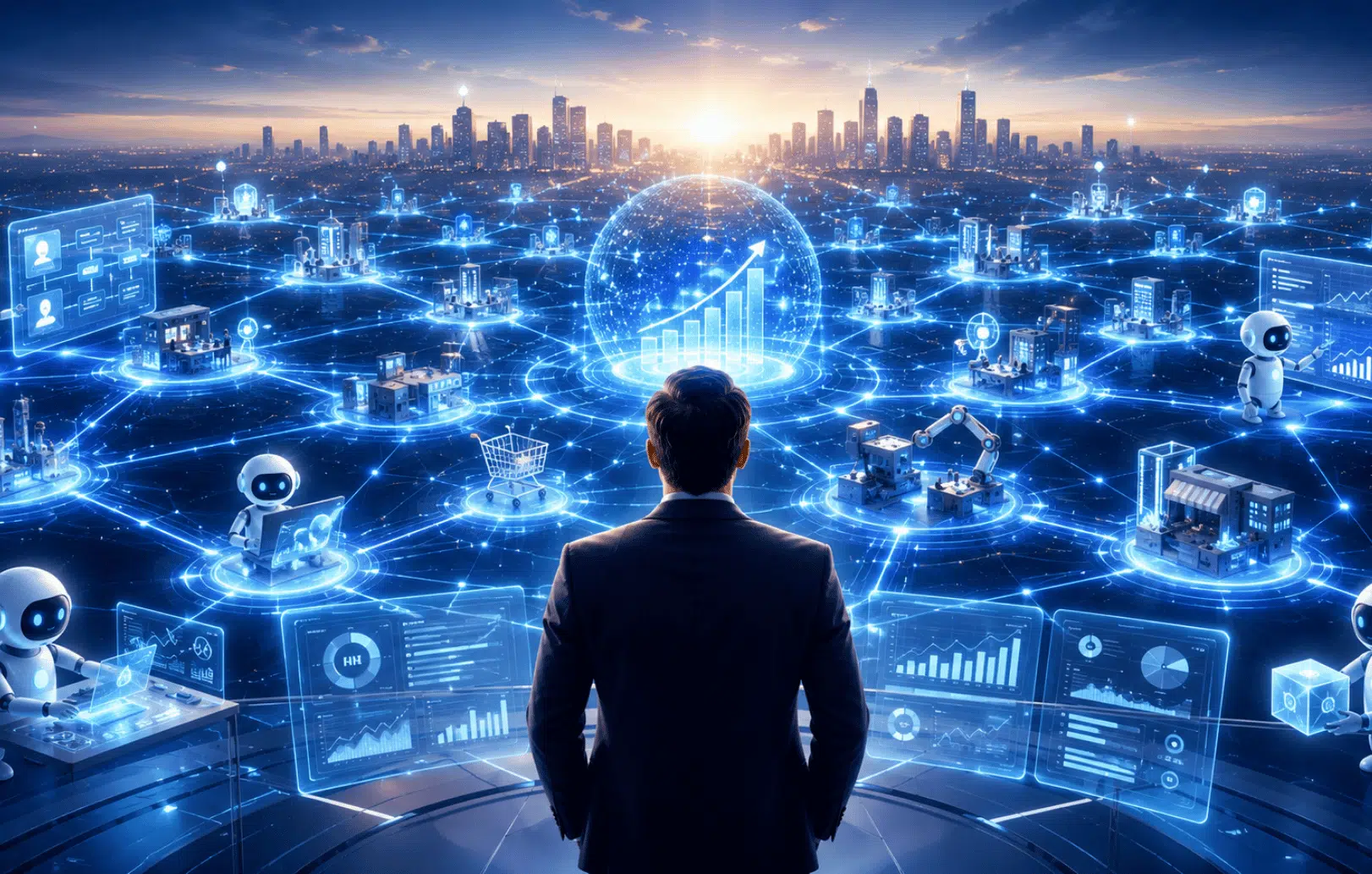
Imagine a business that identifies an opportunity, validates demand, creates products, builds marketing campaigns, launches websites, acquires customers, handles support, manages operations, optimizes pricing, and expands into adjacent markets with minimal human involvement. Now imagine thousands of those businesses. Then millions.
This is where I believe the world is heading.
At gotcha!, we call our version of this concept The Biz Factory. The Biz Factory is not just about building AI tools. It’s about creating systems capable of identifying opportunities, launching businesses, operating businesses, and continuously improving businesses at scale.
Not one company. Not ten companies. Tens of thousands.
Some will fail. Some will survive. Some will dominate categories that do not even exist yet.
The economics become difficult to comprehend. Historically, every successful company required a founder, a leadership team, employees, expertise, capital, time, and luck. Tomorrow’s companies may require far less of each. The barriers to entry collapse. The barriers to execution collapse. The barriers to intelligence collapse.
When that happens, competition itself changes. The future may not belong to the largest companies. It may belong to the fastest systems. And the fastest systems will increasingly be autonomous.
Many people fear AI because they think it will take jobs. That is true. But I do not think job loss is the most important consequence. The larger consequence is that AI is forcing humanity to confront a question we have avoided for a long time:
What is human value when competence is no longer scarce?
That question is coming whether we are prepared for it or not. The world was built around the assumption that intelligence was rare. The next world will be built around the assumption that intelligence is abundant.
Everything changes after that.
Many people believe there are certain things AI will never take: creativity, strategy, leadership, entrepreneurship, decision-making. These are comforting beliefs, but history suggests we should be careful with comforting beliefs.
For centuries, humans have mistaken what is possible. We once believed only humans could play chess at a high level. Then only humans could beat grandmasters. Then only humans could create art. Then only humans could write. Then only humans could code. Then only humans could reason.
The list keeps getting shorter.
The mistake is assuming intelligence itself is the scarce resource. It is not. Intelligence is rapidly becoming abundant. What remains scarce is ownership, responsibility, accountability, and consequence.
Someone must still decide what should be built. Someone must still decide which risks are acceptable. Someone must still own the outcome when things go wrong. Someone must still answer the question: should we?
AI can increasingly answer how. It can even help answer what. But the question of why still belongs to those willing to bear the consequences. At least for now.
That may be humanity’s final monopoly. Not intelligence. Not creativity. Not knowledge. Not labor. Responsibility.
The willingness to own outcomes. The willingness to carry risk. The willingness to accept consequences.
Ironically, many people have spent their lives avoiding responsibility, ownership, and consequences. Yet those very things may become the most valuable assets humans possess. In a world where machines can perform nearly any task, the people who rise will not necessarily be the smartest. They will be the ones willing to take responsibility for decisions that matter.
The entrepreneur. The investor. The parent. The leader. The builder. The owner.
These roles are not defined only by intelligence. They are defined by accountability. And accountability may become the last remaining source of human leverage.