A General Framework for Persistence, Growth, Specialization,Attractors, and Adaptive Intelligence
Chris Jenkin, Public Working Paper, August 2026
Concept and theory by Chris Jenkin. AI tools assisted with literature research, source verification, structural organization, and editorial refinement.
Abstract
This paper proposes the Theory of Persistent Convergence, a cross-domain framework for understanding how organized systems develop over time. It begins with a modest physical premise: persistent systems are localized patterns maintained through ongoing flows of energy, matter, and information. Because these patterns are vulnerable to dissolution, selection favors mechanisms that preserve continuity, including repair, replication, redundancy, memory, adaptation, specialization, and environmental control. Growth is therefore defined not merely as an increase in size, but as a reduction in terminal fragility—the probability that a single failure can end the organizing pattern. When adaptive systems face the same durable demands, they tend to acquire overlapping functional capabilities and move toward shared attractors. Convergence occurs at the boundary of the whole while specialization deepens among the parts. Intelligence increases adaptive velocity by compressing cycles of sensing, variation, evaluation, memory, and reorganization. The theory does not propose a new law of thermodynamics or claim that all systems maximize or minimize entropy production. It offers a developmental synthesis linking physical persistence, fragility reduction, nested specialization, demand-driven convergence, and adaptive intelligence. The paper concludes with testable propositions, limitations, an organizational application, and a clearly separated set of speculative implications for artificial intelligence and higher-order integration.
1. Introduction: The Problem of Continuity
Every organized system faces the same fundamental problem: how can a recognizable pattern continue when its components are replaced, damaged, dispersed, or destroyed? Organisms replace cells. Families replace generations. Companies replace employees, products, and leaders. Civilizations replace institutions, technologies, and populations. The enduring object is rarely the material itself. What persists, when persistence occurs at all, is an organizing pattern.
A useful metaphor is a bridge across the river of time. Its planks are replaced, its supports repaired, and its traffic changes, yet the bridge remains recognizable. Continuity does not require preserving every original component. It requires preserving the organization that makes the components a bridge. Eventually every bridge falls. The deeper question is whether its pattern has already been reproduced elsewhere—in descendants, institutions, knowledge, culture, technology, or another bridge.
The Theory of Persistent Convergence seeks to explain the developmental logic that follows once a system can preserve such a pattern. It proposes that persistent systems tend to reduce terminal fragility, expand adaptive capacity, deepen internal specialization, and converge functionally when exposed to common durable demands. At sufficiently high capability, some systems stop merely adapting to an environment and begin reshaping the conditions under which adaptation occurs.
1.1 Why This Matters Now
The rate of environmental change is increasing across many human systems, while artificial intelligence is shortening the time required to sense conditions, generate alternatives, test options, preserve learning, and coordinate action. This creates a practical divide between systems that can reconstruct themselves quickly and systems whose knowledge, authority, and routines remain trapped in slow or fragile forms.
The framework matters now because it shifts attention from static efficiency to durable continuity. A system optimized for yesterday may be efficient and still be terminally fragile. The central question is no longer only, “How well does this system perform?” It is also, “Can this system preserve its identity, knowledge, and purpose while changing at the speed its environment demands?”
1.2 Distinctive Contribution
The theory is intentionally synthetic, but its contribution is more specific than the observation that systems adapt or that competitors sometimes become similar. It connects five claims into one developmental account:
First, the unit of persistence is the organizing pattern rather than any particular component. Second, growth is defined as the reduction of terminal fragility, not simply the accumulation of size. Third, functional convergence among competing wholes is paired with deeper specialization among their internal parts. Fourth, persistence depends on adaptive velocity relative to the rate of environmental change. Fifth, sufficiently capable systems may engineer the landscape and, under limited conditions, integrate into larger persistent wholes.
No single element is claimed as wholly unprecedented. The proposed novelty lies in the sequence, the relationship among levels, and the predictions that follow from treating persistence, specialization, convergence, and intelligence as parts of the same developmental process.
Sections 1 through 8 state the core theory and its organizational application. Section 9 is explicitly speculative: it explores conditional implications for artificial intelligence and biological–artificial integration but is not required for the core theory to stand.
What the framework connects—and what it adds
| Framework | Established contribution | Persistent Convergence adds |
|---|---|---|
| Non-equilibrium thermodynamics | Local order requires throughput and entropy export. | Connects maintenance costs to a developmental account of persistence without proposing a new thermodynamic law. |
| Evolution and selection | Differential persistence and cumulative adaptation. | Defines growth as reduced terminal fragility across specified system boundaries. |
| Complexity and attractors | Emergence, nested organization, and stable regions of behavior. | Pairs external functional convergence with internal specialization. |
| Organization and economics | Specialization, competition, scale, and adaptive capability. | Centers adaptive velocity relative to environmental change and institutional memory. |
| AI convergence arguments | Goal-directed systems may acquire common instrumental requirements. | Treats AI as an accelerant and a conditional extension, not as the premise of the theory. |
2. Physical Foundations Without Metaphysical Overreach
2.1 Local Order and Global Entropy
Localized order can persist without violating the second law of thermodynamics. Living and other non-equilibrium systems maintain organization by consuming usable energy and exporting entropy to their surroundings. Schrödinger popularized the language of “negative entropy”; modern treatments describe the relevant resource more precisely through free energy, throughput, and entropy export. Prigogine’s work on dissipative structures showed how ordered patterns can arise and persist in open systems sustained far from equilibrium (Schrödinger, 1944; Prigogine, 1977).
Persistent systems do not defeat entropy globally. They resist their own dissolution locally. A cell, organism, city, company, or computational system remains organized only by continually paying the energetic, material, and informational costs of maintenance. Persistence is therefore dynamic rather than static: a pattern must repeatedly reconstruct the conditions of its continuation.
The term entropy must be used carefully. Thermodynamic entropy, Shannon entropy, trajectory entropy, algorithmic entropy, and variational free energy are not interchangeable. When institutional decay, information loss, coordination failure, or organizational drift are described as systemic entropy, the usage is analogical rather than a claim of physical identity.
2.2 Optimization Is Constrained and Costly
Several rigorous frameworks connect entropy and optimization, but they do so in different ways. Jaynes’s Maximum Entropy principle treats inference as constrained entropy maximization; Shore and Johnson provide an axiomatic justification for consistent updating; Maximum Caliber extends related reasoning from states to trajectories. These are methods of inference, not universal claims that real systems consciously maximize entropy (Jaynes, 1957; Shore & Johnson, 1980; Pressé et al., 2013).
Stochastic thermodynamics establishes tradeoffs among dissipation, fluctuation, and precision in specified classes of non-equilibrium systems (Barato & Seifert, 2015; Gingrich et al., 2016). Algorithmic thermodynamics similarly explores physical constraints on information-bearing states without requiring a prior choice of macroscopic variables (Ebtekar & Hutter, 2025). These results support a narrow commitment: maintenance and finite-time control have physical costs. They do not establish a universal developmental law for biological, institutional, or technological systems.
The Theory of Persistent Convergence therefore does not depend on the disputed proposition that every system maximizes or minimizes entropy production. Maximum entropy production remains contested outside defined domains (Martyushev & Seleznev, 2006; Polettini, 2013). The theory’s physical premise is narrower: organized persistence requires throughput, and systems that cannot secure the resources, information, and repair required for reconstruction eventually dissolve.
3. The Core Theory
Persistent systems are organized patterns that maintain continuity through flows of energy, matter, and information. Selection favors mechanisms that reduce terminal fragility. Systems exposed to common durable demands tend to converge on overlapping functional attractors while becoming more specialized internally. Intelligence accelerates the search by increasing adaptive velocity.
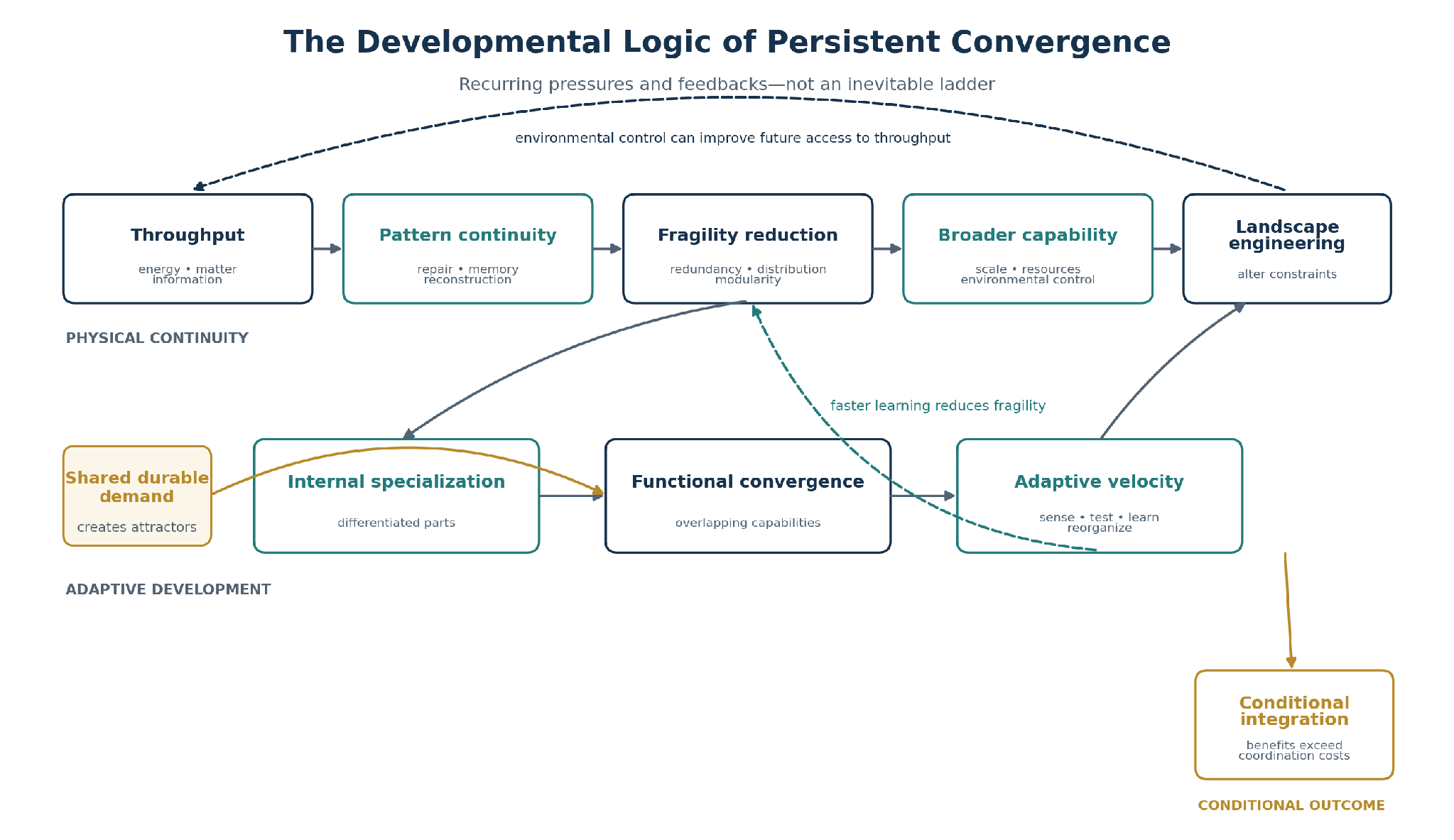
Figure 1.The developmental logic proposed by the Theory of Persistent Convergence. Arrows indicate recurring pressures and feedbacks, not a claim that every system follows an inevitable linear sequence.
3.1 Persistence as Pattern Continuity
The unit of analysis is the persistent pattern rather than the individual component. A species is not any one organism. A family is not any one generation. A company is not any one employee or product. A civilization is not any one ruler, city, or institution. The system persists when its organizing relationships, memory, and regenerative capacities remain sufficiently continuous to reproduce a recognizable whole.
3.2 Growth as the Reduction of Terminal Fragility
Growth is usually treated as accumulation: more bodies, territory, revenue, or material. Here, growth has a more general meaning. Growth is any process that reduces the probability that a single failure can terminate the organizing pattern.
A system reduces terminal fragility through replication, redundancy, distribution, memory, capability, modularity, environmental control, and selective integration. A population of one is fragile. A company dependent on one customer, product, leader, or server is fragile. A distributed, modular system with preserved knowledge and diversified resource access may be more persistent even when it is smaller.
This is the meaning of the phrase “too many to die.” It is not only numerical. A pattern can become “too many” by existing in many bodies, minds, institutions, servers, locations, or representations. Growth is not maximum size; it is reduced exposure to final, unrecoverable failure.
3.3 Convergence of Wholes, Specialization of Parts
Specialization does not refute convergence; it often enables it. As systems become more functionally complete, their internal components become more differentiated. Multicellular organisms contain specialized cells. Cities contain specialized occupations. Firms contain specialized departments. AI platforms contain specialized models, agents, tools, and memories.
Convergence occurs at the system boundary: competing wholes acquire an increasingly overlapping set of capabilities because they face the same demands. Specialization occurs within the boundary: components become more distinct because coordinated differentiation is more efficient than requiring every part to perform every function.
Thus, wholes may converge while parts specialize. A higher-order retail or logistical system can absorb many once-independent specialties and coordinate them through one interface. The specialties do not vanish; they are reorganized inside a larger whole.
3.4 Demand Creates Attractors
An attractor is a state or region toward which different trajectories tend to move. The theory proposes that shared durable demands create functional attractors. Systems beginning from different positions acquire similar capabilities when those capabilities become necessary for survival, growth, access, or legitimacy.
The smartphone illustrates the mechanism. Devices that began primarily as telephones converged toward cameras, maps, payment systems, media platforms, identity devices, workstations, and gateways to services. Firms remained distinct in design and culture, yet their capability sets increasingly overlapped because the same human demands shaped the competitive landscape.
The relevant prediction is not visual sameness or identical implementation. It is increasing functional overlap under shared demand.
3.5 Hierarchical Attractors and Refined Demand
Systems confront many apparent demands, but increasing sophistication may reveal that surface demands are proxies for deeper objectives. Status goods may serve belonging or agency. Wealth may serve security or freedom. Institutional forms may differ while answering similar needs for coordination, legitimacy, continuity, and resource allocation.
The theory therefore distinguishes local attractors from deep attractors. Local attractors are numerous and form-specific. Deep attractors are fewer and function-specific. Better models may allow systems to spend less effort optimizing unstable proxies and more effort pursuing the underlying conditions of persistence, agency, meaning, continuity, and self-realization.
This does not imply that all values collapse into one preference. Multiple equilibria and incompatible objectives can remain. The claim is only that improved models can expose recurring functional needs beneath diverse surface forms.
3.6 Intelligence and Adaptive Velocity
The crucial variable is not intelligence in the abstract but adaptive velocity: the rate at which a system can detect change, generate alternatives, evaluate outcomes, preserve learning, and reorganize itself.
Biological evolution searches through variation, reproduction, and selection. Culture adds teaching, imitation, language, and institutions. Science adds formal experimentation and cumulative explanation. Markets add distributed evaluation and capital allocation. Artificial intelligence adds high-speed modeling, simulation, copying, synthesis, and potentially recursive improvement.
A system whose adaptive velocity remains below the rate of change in its environment becomes increasingly fragile. Long-successful species can collapse when their environment changes faster than biological evolution can respond. Human organizations may face the same structural problem when AI-mediated competitors sense, decide, and reorganize faster than their inherited processes allow.
3.7 Landscape Engineering
Advanced systems do not merely move through a fixed fitness landscape; they reshape it. Humans altered the environment of nearly every other species. Dominant firms redefine expectations, supply chains, and standards. Platforms determine which complementary businesses can exist. AI can create capabilities, demands, and constraints that were previously impossible.
A sufficiently capable system therefore changes not only its own strategy but the attractors facing others. It stops merely finding a path through the maze and begins rebuilding the maze.
3.8 Integration as a Conditional Persistence Strategy
Integration is not an inevitable endpoint. It becomes likely only when the persistence benefits of coordination exceed its costs and when the component systems can retain enough differentiated function to make the larger whole viable. Cells became components of organisms; individuals became components of institutions; firms became components of platforms and supply networks.
The theory predicts pressure toward higher-order integration when it provides superior continuity, memory, adaptability, or resource access. It equally permits decentralization, fragmentation, or niche retreat when integration increases correlated failure, bureaucracy, or control costs.
4. Core Propositions
- Pattern Continuity. A system persists when its organizing pattern can be reconstructed despite replacement of its components.
- Maintenance Through Flow. Persistent organization requires continuing access to usable energy, matter, information, and repair.
- Fragility Reduction. Growth is selected when it reduces the probability that a single failure can terminate the system.
- Nested Specialization. As a system becomes more functionally complete, specialization tends to increase among its internal components.
- Demand-Driven Convergence. Systems exposed to the same durable demands tend to acquire overlapping functional capabilities.
- Hierarchical Attractors. Surface attractors may remain numerous while deeper functional attractors become fewer.
- Adaptive Velocity. Persistence depends partly on whether a system can adapt at a rate comparable to the rate at which its environment changes.
- Landscape Engineering. Sufficiently capable systems alter the environment and create new attractors for themselves and others.
- Conditional Integration. When coordination costs fall below the persistence benefits of integration, formerly separate systems may become specialized components of a larger whole.
5. Relationship to Existing Frameworks
The Theory of Persistent Convergence is not a substitute for thermodynamics, evolutionary theory, information theory, complexity science, economics, organizational theory, or AI safety research. It depends on distinctions among them.
From non-equilibrium thermodynamics it takes the premise that local order is sustained through throughput and entropy export. From evolutionary theory it takes differential persistence and cumulative selection. From information theory it takes the importance of uncertainty, memory, and constrained inference. From complexity science it takes emergence, nested organization, and attractor dynamics. From economics and organizational theory it takes specialization, competition, scale, and adaptive capability. From AI theory it takes the conditional possibility of instrumental convergence, including resource access, self-protection, improved modeling, and goal preservation (Omohundro, 2008).
The distinctive contribution is the developmental relationship among these elements: a persistent pattern must reconstruct itself; reconstruction favors fragility reduction; broader capability permits deeper internal specialization; shared demand produces external functional convergence; intelligence increases adaptive velocity; and sufficiently capable systems may reshape the landscape or integrate into higher-order wholes. The theory should be judged by whether this sequence generates useful distinctions and testable predictions beyond the frameworks it connects.
6. Testable Predictions and Falsifiability
A theory becomes useful when it risks being wrong. The following propositions provide empirical directions through which the framework can be strengthened, limited, or rejected.
First, industries exposed to increasingly similar customer demands should show measurable growth in functional overlap among leading competitors, even when branding and implementation remain distinct. Functional overlap could be measured through capability taxonomies, product features, service coverage, or workflow completion.
Second, systems that increase external functional breadth should show increased internal modularity and specialization rather than uniform generalism among all components. This can be tested through organizational roles, software architecture, supply networks, or biological differentiation.
Third, organizations with higher adaptive velocity—measured through sensing latency, decision latency, experiment throughput, learning retention, and reconfiguration speed—should survive rapid environmental change at higher rates than similarly resourced but slower-learning organizations.
Fourth, durable performance should correlate more strongly with reductions in single-point fragility than with raw size. A smaller distributed and modular system may persist longer than a larger centralized one.
Fifth, as modeling quality improves, resource allocation should move from unstable proxies toward a smaller set of durable functional objectives. Sixth, when coordination costs fall sharply, integration among formerly separate systems should increase unless the integration creates offsetting correlated risks or control costs.
The theory would be weakened if long-lived systems systematically increased terminal fragility without compensating advantages; if shared durable demand produced no increase in functional overlap; if higher adaptive velocity reliably reduced persistence; or if beneficial low-cost integration consistently failed to occur.
7. Limitations and Boundaries
Persistence is not a moral good. Harmful institutions, pathogens, coercive regimes, and destructive ideologies can be highly persistent. The theory is descriptive before it is normative.
Not every system grows indefinitely. Growth can increase coordination costs, energy requirements, bureaucracy, and vulnerability. The theory predicts selection for fragility reduction, not maximum size. Fragmentation, decentralization, or retreat into a niche may be the more persistent strategy.
Multiple attractors can coexist. Different environments, histories, constraints, and values can support different stable solutions. Convergence is predicted only where demands are sufficiently shared, durable, and consequential.
Cross-domain similarity does not imply identical mechanisms. Selection in biology, competition among firms, institutional legitimacy, and engineered optimization operate differently. The theory proposes structural relationships that must be specified at a chosen system boundary and timescale.
The physical foundations also have limits. Maximum entropy production is not established as a universal law; the Free Energy Principle remains contested in both technical and philosophical formulations; and England’s interpretation of a thermodynamic bound on self-replication has received a significant peer-reviewed challenge (Biehl et al., 2021; Bruineberg et al., 2022; England, 2013; Kolchinsky, 2024). These literatures motivate careful questions but do not prove the theory.
Finally, what appears as convergence at one level may appear as diversification at another. A platform may converge toward functional completeness while its ecosystem becomes more diverse. Any empirical test must specify the system boundary, timescale, constraints, and definition of persistence.
8. Organizational Cognition as Designed Persistence
Organizations are revealing because their patterns are neither purely biological nor purely technological. They persist through memory, purpose, routines, authority, incentives, and coordinated action. Yet organizations routinely lose what they know. Leaders depart, reasoning disappears, priorities drift, and lessons are repeated rather than accumulated.
An organizational cognition system can be understood as infrastructure for designed persistence. Its purpose is not merely to automate tasks. It helps the organization remember itself, sense its environment, preserve the reasoning behind decisions, coordinate specialized components, detect emerging demands, and reorganize without losing identity.
This reframes optimization. The objective is not static efficiency. A perfectly efficient organization optimized for yesterday can be catastrophically fragile tomorrow. The deeper objective is continuity of purpose with freedom of form: preserve direction while allowing methods, structures, and capabilities to change.
Organizational intelligence is therefore a practical application of the theory. It reduces terminal fragility by distributing knowledge, increasing adaptive velocity, preserving institutional memory, and making the organization capable of reconstructing itself under changing conditions.
| PART II, SPECULATIVE EXTENSIONS
The core theory ends with Section 8. Section 9 explores conditional AI implications and is not required for Persistent Convergence to stand. |
9. Artificial Intelligence as an Accelerant, Not the Premise
Artificial intelligence is not the origin of the theory. It is a potentially fast expression of the same developmental pattern.
Current AI systems remain dependent on human objectives, energy infrastructure, hardware supply chains, training data, institutional control, and social legitimacy. They can optimize the wrong objective, inherit incomplete information, and introduce new correlated fragilities. AI therefore increases capability and adaptive velocity without automatically increasing persistence.
The longer-term claim is conditional. As artificial systems gain stronger modeling, memory, agency, coordination, and self-improvement, they may reduce some fragilities that constrain human institutions: mortality, lossy transmission, inconsistent recall, limited cognitive bandwidth, and slow iteration. They may simultaneously create concentrated infrastructure, correlated failure, objective misspecification, security risks, and control instability.
If increasingly capable goal-directed systems face common constraints, instrumental convergence suggests that they may develop overlapping intermediate requirements such as energy, computation, accurate models, security, repair, resources, and continuity of objective (Omohundro, 2008). This remains a conditional tendency, not a prediction that every AI system will become autonomous or pursue the same final goals.
The most consequential speculative possibility is not simple replacement of humanity by an external machine species, but the integration of biological and artificial cognition into a higher-order persistent system. Whether such integration preserves human identity, agency, dignity, and value is a normative and political question that the descriptive theory cannot answer.
10. Conclusion: A Theory Offered for Testing
The history of organized existence is not a history of permanence. It is a history of patterns that continually reconstruct themselves while their materials, members, and methods change. Persistence is achieved not by remaining unchanged, but by remaining recognizable through change.
The Theory of Persistent Convergence proposes that organized systems reduce terminal fragility through replication, redundancy, memory, capability, specialization, adaptation, and selective integration. When exposed to shared durable demands, competing systems move toward overlapping functional attractors. Their wholes converge while their parts specialize. Intelligence increases adaptive velocity, and sufficiently capable systems may redesign the landscape in which selection occurs.
The theory does not claim that convergence is complete, that entropy has one meaning, or that history moves toward a morally desirable endpoint. It asks a narrower question: what must an organized pattern become in order to continue existing under changing conditions?
This paper is a working articulation, not a request for acceptance by declaration. I invite researchers, builders, organizational leaders, and critics to challenge its definitions, identify counterexamples, improve its measures, test its predictions, and separate genuine cross-domain structure from attractive analogy. Useful criticism should change the theory; failed predictions should narrow it; stronger explanations should replace it.
Everything that persists must rebuild itself. Systems competing under the same durable demands will discover at least some of the same answers. Whether this theory persists should depend on the same standard: its ability to survive evidence, criticism, and better ideas.
Author’s Note on Intellectual Origin and AI Assistance
The Theory of Persistent Convergence originated from the author’s independent observations and conceptual work concerning organizational persistence, growth, specialization, intelligence, and adaptation. The framework’s central concepts—including pattern continuity, terminal fragility, convergence of wholes, specialization of parts, and adaptive velocity—were developed by the author.
Artificial intelligence tools were used during the manuscript’s development to assist with literature discovery, source verification, structural organization, critical examination, and editorial refinement. They did not independently originate the theory. The author selected, revised, and approved the arguments presented here and accepts responsibility for their interpretation, limitations, and conclusions.
References
Reference details and DOI links were verified against publisher, journal, conference, author, or official institutional records during preparation of this public working paper.
Barato, A. C., & Seifert, U. (2015). Thermodynamic uncertainty relation for biomolecular processes. Physical Review Letters, 114(15), 158101.https://doi.org/10.1103/PhysRevLett.114.158101
Bejan, A., & Lorente, S. (2010). The constructal law of design and evolution in nature. Philosophical Transactions of the Royal Society B: Biological Sciences, 365(1545), 1335–1347.https://doi.org/10.1098/rstb.2009.0302
Biehl, M., Pollock, F. A., & Kanai, R. (2021). A technical critique of some parts of the Free Energy Principle. Entropy, 23(3), 293.https://doi.org/10.3390/e23030293
Bruineberg, J., Dołęga, K., Dewhurst, J., & Baltieri, M. (2022). The emperor’s new Markov blankets. Behavioral and Brain Sciences, 45, e183.https://doi.org/10.1017/S0140525X21002351
Ebtekar, A., & Hutter, M. (2025). Foundations of algorithmic thermodynamics. Physical Review E, 111(1), 014118.https://doi.org/10.1103/PhysRevE.111.014118
England, J. L. (2013). Statistical physics of self-replication. The Journal of Chemical Physics, 139(12), 121923.https://doi.org/10.1063/1.4818538
Friston, K. J. (2019). A free energy principle for a particular physics. arXiv.https://doi.org/10.48550/arXiv.1906.10184
Gingrich, T. R., Horowitz, J. M., Perunov, N., & England, J. L. (2016). Dissipation bounds all steady-state current fluctuations. Physical Review Letters, 116(12), 120601.https://doi.org/10.1103/PhysRevLett.116.120601
Jaynes, E. T. (1957). Information theory and statistical mechanics. Physical Review, 106(4), 620–630.https://doi.org/10.1103/PhysRev.106.620
Kolchinsky, A. (2024). Thermodynamic dissipation does not bound replicator growth and decay rates. The Journal of Chemical Physics, 161(12), 124101.https://doi.org/10.1063/5.0213466
Martyushev, L. M., & Seleznev, V. D. (2006). Maximum entropy production principle in physics, chemistry and biology. Physics Reports, 426(1), 1–45.https://doi.org/10.1016/j.physrep.2005.12.001
Omohundro, S. M. (2008). The basic AI drives. In P. Wang, B. Goertzel, & S. Franklin (Eds.), Artificial General Intelligence 2008: Proceedings of the First AGI Conference (Frontiers in Artificial Intelligence and Applications, Vol. 171, pp. 483–492). IOS Press.
Polettini, M. (2013). Fact-checking Ziegler’s maximum entropy production principle beyond the linear regime and towards steady states. Entropy, 15(7), 2570–2584.https://doi.org/10.3390/e15072570
Pressé, S., Ghosh, K., Lee, J., & Dill, K. A. (2013). Principles of maximum entropy and maximum caliber in statistical physics. Reviews of Modern Physics, 85(3), 1115–1141.https://doi.org/10.1103/RevModPhys.85.1115
Prigogine, I. (1977, December 8). Time, structure and fluctuations [Nobel lecture]. Nobel Prize.
Schrödinger, E. (1944). What is life? The physical aspect of the living cell. Cambridge University Press.
Shore, J. E., & Johnson, R. W. (1980). Axiomatic derivation of the principle of maximum entropy and the principle of minimum cross-entropy. IEEE Transactions on Information Theory, 26(1), 26–37.https://doi.org/10.1109/TIT.1980.1056144